


2005 Ford Mustang GTR Concept
NEW YORK, April 7, 2004 – The muscular Ford Mustang GT-R rekindles the legend’s road racing glory and the magic of 5.0-liter Mustangs in a stunning racing concept making its world debut today. The Mustang GT-R signals a potential future race car, while honoring four decades of performance glory just days before Mustang’s 40th anniversary.
“The Mustang GT-R blends today’s breathtaking design, Ford Racing’s unmatched history and the most advanced racing technology into the ultimate Mustang,” says J Mays, Ford group vice president, design. “Mustang’s iconic image grew with every checkered flag so we think the Mustang GT-R is an appropriate tribute to the car’s 40th anniversary, and a hint at what’s to come.”
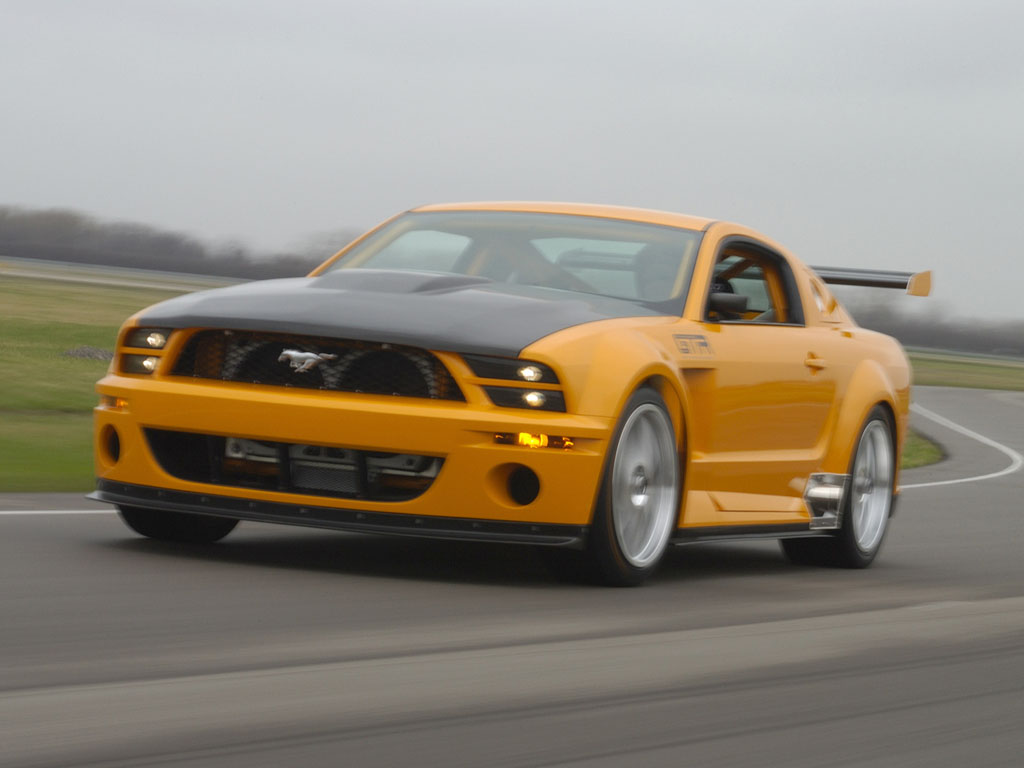
The bright Valencia Orange car – inspired by the famous Grabber Orange 1970 Mustang Boss 302 Trans-Am race cars (the Yellow Mustangs) piloted by race legends, including Parnelli Jones – is a technological showcase that, when peeled back, reveals a number of existing or production-feasible racing parts.
“The Mustang GT-R shows that Ford is back in road racing in a serious way,” says Jim O’Connor, Ford group vice president, North America marketing, sales and service.
The Mustang GT-R features Ford Racing’s 440-horsepower “Cammer” crate engine that already is affordably available to grassroots racers, and can be tuned to produce more than 500 horsepower under certain race series rules. Last year, a tuned 505-horsepower version of the “Cammer” notched world-class performance and endurance credentials by powering a Focus Daytona Prototype to victory at the 24 Hours of Daytona race.
The racecar is engineered to tackle the world’s toughest road and street courses with a stiff structure – based on the all-new 2005 Mustang scheduled for sale this fall – a collection of the most sophisticated racing parts from many racing series and a Formula One-inspired steering wheel. However, the Mustang GT-R could be easily transformed into an affordable, competitive option for grassroots teams because it uses 85 percent of the 2005 Mustang’s body components along with the same suspension setups and the already-attainable “Cammer” powerplant.
“The GT-R is the Mustang racers would build if they weren’t bound by various road racing rules,” says Dan Davis. “We were fortunate to start with a rigid, well-balanced production Mustang that was proven on the track by some of the same people who, in previous jobs, helped Ford Racing win on Sundays.
“The Mustang GT-R could be adapted to conform to different series and budgets but, in this variation, serves as a dream machine. We took the ‘Cammer’ engine from the Ford Racing catalog and built a race car around it with the best parts we’ve researched and tested through our unmatched global racing program,” Davis says.
While conceptual in spirit, the Mustang GT-R is built by racers and is a capable performer with an eye on stepping up Mustang’s road-racing presence. Several racing series – American LeMans, SCCA Trans-Am, GrandAm Cup and the FIA – could easily accommodate the Mustang GT-R. For example, the car could meet some series rules with basic modifications to the brakes, wheels, tires and body parts.
The Mustang GT-R also hints at a turnkey grassroots-racing package that could be retailed through Ford Racing’s parts’ catalog and distribution network.
Engine Dressing
Doug Gaffka’s – design director, Ford Performance Group – design inspiration for the Mustang GT-R was simple: Flex the 2005 Mustang shell to wrap the engine and retain 85 percent of the production car’s solid structure.
“We decided that when a car as good as the 2005 Mustang comes along, we don’t need to look much further for a pure race car,” he says, noting that the Mustang’s shell would be dressing for the engine and roll cage.
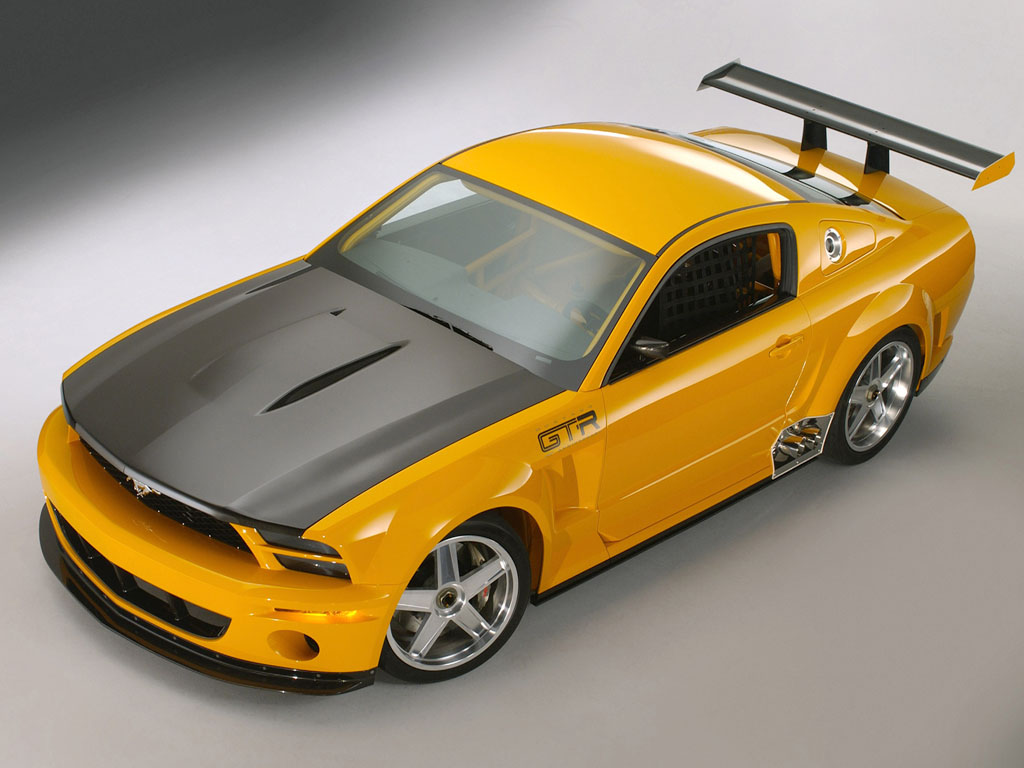
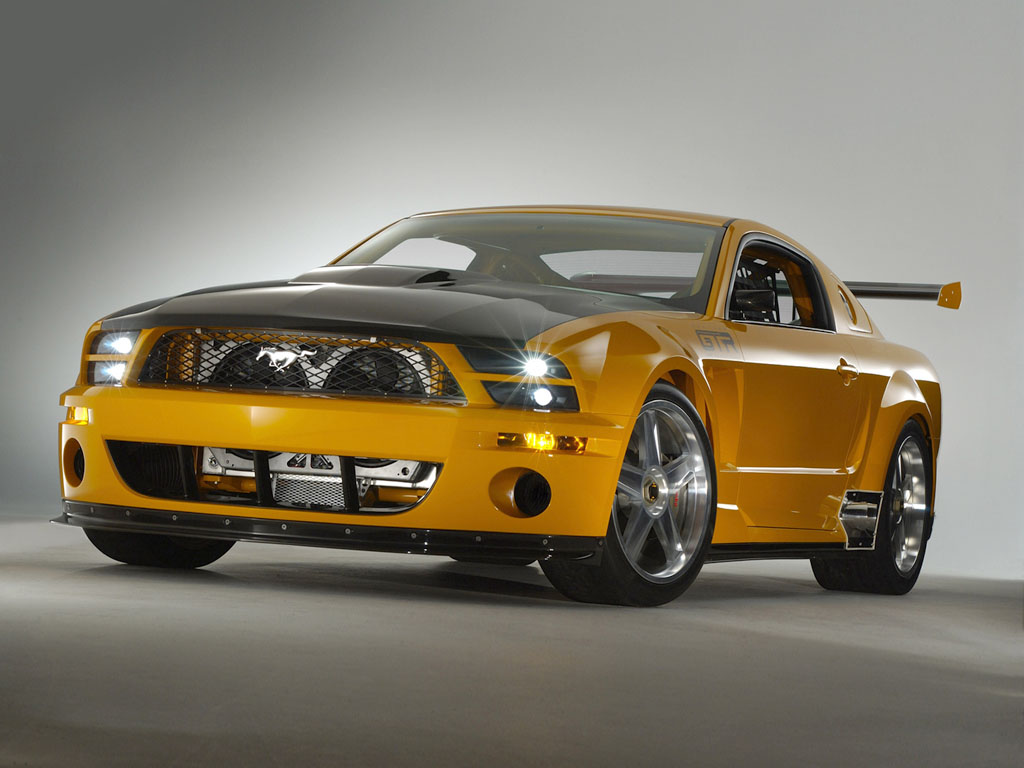
The carbon fiber hood instantly communicates the car’s performance – its large engine bulge and unfinished surface harken back to the famous yellow, black-hooded Mustangs..
The front end is a further evolution of the Mustang GT coupe and convertible concepts that stole the 2003 North American International Auto Show and foreshadowed the design of the 2005 Mustang. The Mustang GT-R features the classic pony in the grille, surrounded by modern materials like carbon fiber as well as advanced aerodynamic treatments like ground-hugging front and side splitters.
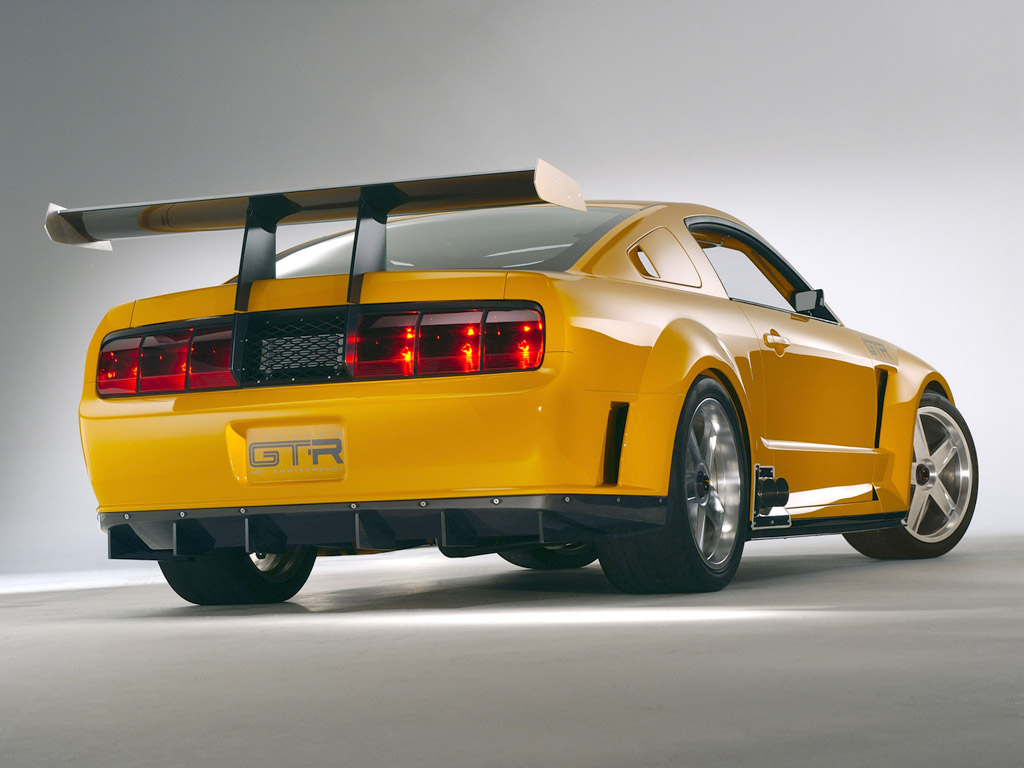
Accentuated by huge front fender flares that accommodate the racing suspension, the sides of the Mustang GT-R have 20-inch wheels, racing slicks and substantial air scoops. The equally large rear fenders house tires that are an inch wider. Considering how quickly 18- and 19-inch tires became standard racing ware in recent years, these tires are a realistic forecast of the next evolution in racing rubber. Dual stainless steel exhaust tips — jutting out of the rear body panel just above the rocker panel on both sides in front of the tires – add an intimidating look to the rear of the car.
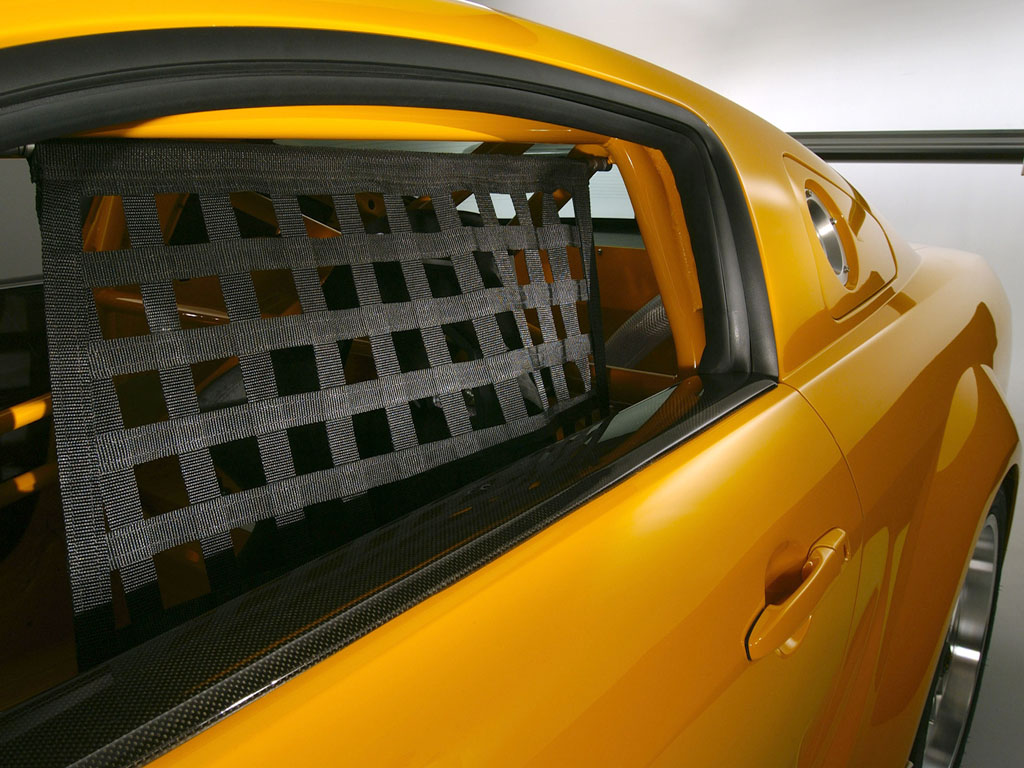
The classic Mustang rear quarter windows are blocked out to accommodate the fuel delivery “dry-break” system on the driver’s side. The doors are fully functional as required by many of the possible racing classes.
The prominent GT-R logo is placed above the front fender and is flanked by the honorary “Mustang” and “40th Anniversary” words. This logo is repeated on the rear.
Probably the most striking design element, the prominent composite rear spoiler meets several road racing sanctioning body rules.
The rear fascia, like the front, is a further expression of the GT concept design, with a wider taillamp execution. Endurance racers will instantly recognize the differential cooler mounted with an aluminum grille screen between the taillamps.
Inside, the instrument panel preserves the dramatic styling of the 2005 Mustang in a carbon fiber application for racing. In anticipation of another trend, designers chose a Formula One-style steering wheel with most vehicle controls and gauges integrated, including the tachometer, gear selections, telemetry and warning signals. Only the oil pressure and water temperature gauges are located on the instrument panel.
“Most racers cobble together interiors,” says Gaffka. “The Formula One-style steering wheel significantly reduces dash gauges to help preserve Mustang’s powerful instrument panel, which is the next evolution of our interior design leadership.”
The passenger side houses seat mount tracks for a second seat, if needed, for would-be thrill seekers seeking first-hand Mustang GT-R’s performance experience. The chrome-moly roll cage is attached to all significant points in the body structure, adding significant rigidity to an already stiff body.
The Mustang GT-R’s body retains 85 percent of the production car’s body components that were stiffened by 30 percent as part of the Mustang’s first full makeover ever. The only modifications include rear-mounted battery pods and a fuel cell relocated to the rear trunk.
Built at Saleen Special Vehicles in Troy, Mich., the car was developed by the same members of the Ford GT “Dream Team” who are building sub-assemblies and painting body panels for Ford’s first supercar.
The “Five Liter” Is Back
The foundation for the Mustang GT-R’s race-prepared 440-horsepower engine is the new 5.0-liter “Cammer” crate engine from Ford Racing Performance Parts. The engine is rooted in the MOD 4.6-liter four-valve V-8 engine family. However, the motor’s flanged cylinder liners help provide 94mm (instead of 90.2mm) cylinder bores, creating a full 5.0 liters of piston displacement.
And while the motor employs the SVT Mustang Cobra’s forged crankshaft with six-bolt mains and Manley “H-Beam” connecting rods for superior strength, the high-strength Ford Racing block features design reinforcements and a revised material for added strength and high-output durability. The block is specially reinforced in the crankcase web areas for high torque loads.
Other key differences include forged pistons, an 11.0:1 compression ratio, ported heads, higher-lift cams and beehive-shaped valve springs. The crate engine also features higher-flow fuel injectors and a magnesium, variable-geometry intake manifold.
The 5.0-liter “Cammer” engine comes with a custom oil pan and features custom-fabricated Tri-Y headers and crossover.
Helping put the power to the ground is the Ford Racing-supplied TTC T-56 six-speed transmission linked to the engine through a heavy-duty clutch and flywheel assembly. Power exits the transmission through a custom metal matrix composite aluminum driveshaft into a race-specification differential with a 4.56:1 final drive ratio.
The “Cammer” was introduced at the Specialty Equipment Manufacturers Association show in 2002. The engine in the GT-R is identical to the crate engine, with the exception of camshaft timing, which was modified to produce more high-end horsepower for track use.
Proven Race Chassis
The Mustang GT-R benefits from the 2005 Mustang’s race-inspired chassis, developed and tuned by engineers with Ford Racing engineering experience or a passion for weekend track time. The Mustang’s race-bred suspensions, near 50-50 weight distribution and ultra-stiff body structure, are just the beginning of Mustang GT-R’s credentials.
“The GT-R is the ultimate expression of the Mustang platform,” says Hau Thai-Tang, 2005 Mustang chief nameplate engineer. “Mustang spans more of the market than almost any other car – from an under-$20,000 V-6 to a race-ready car in the $40,000 range. The Mustang GT-R shows how we can expand that unmatched reach with the all-new platform.”
Track time – at drag strips and on road courses – was a critical part of the 2005 Mustang’s development, as chassis engineers pushed prototypes to the limit in search of the perfect power-and-handling blend.
“We spent countless hours refining this car on development drives and at the track,” says Mark Rushbrook, 2005 Mustang vehicle development manager. “The car has been to the Nelson Ledges road course in Ohio several times for 24-hour runs and has spent months on Ford’s straightaways and handling courses at our proving grounds in Arizona, Michigan and Florida.”
Soon after the 2005 Mustang’s world reveal in January, race engineers quickly began building on its solid foundation. The Mustang GT-R concept’s chassis was fully stripped down to the body shell to receive custom reinforcement and structural improvements for driver safety on the racetrack. A roll cage was added, along with a Sparco-brand racing seat with a five-point safety harness.
The production suspension geometry is retained, but key parts were replaced to reduce weight or provide additional strength for the rigors of racing. Suspension pieces, including the K-member, are made of lightweight chrome-moly tubing. The race-proven dampers are coil-over, fully adjustable units featuring remote reservoirs. A strut tower brace increases structural rigidity.
Rounding out the chassis package are huge, race-proven Brembo brakes. The front features 14.3-inch rotors with six-piston calipers; the rear has 13-inch rotors with four-piston calipers. Linking the whole package to the racetrack are 20-inch wheels and racing slicks provided by Pirelli. Tire sizes range from 275/35 in front to 305/30 in the rear.
The Mustang GT-R is engineered with modern aerodynamics principles, including a massive front airflow opening and carbon-fiber belly pans that reduce underbody air turbulence.
Concept to Reality
Although the Mustang GT-R is a concept, the car was engineered to perform at racing speeds with parts currently available to weekend racers through the 2004 Ford Racing catalog.
The 5.0-liter EFI “Cammer” crate engine, including the wiring harness kit, will sell for an MSRP of $14,995. The “Cammer” engine takes the guesswork out of installation projects by offering a choice of several length 5.0-liter, 4-valve modular wiring harness kits created specifically to cover the most popular engine swap configurations.
What’s more, harness kits – which include the powertrain control module (PCM) – provide all the necessary electrical connectors, including end terminals, a fuse box, a power distribution box, as well as switch connectors and fuel pump relays.
The roll cage, rear spoiler and some chassis components are all being considered for further development.
Solid Foundation
The Mustang GT-R enjoys the strong bloodlines of the 2005 Ford Mustang that was introduced in January as the first Mustang ever with its own dedicated platform. The new platform is six inches longer, 30 percent stiffer and features a sophisticated solid rear axle.
Working on a clean sheet of paper, Mustang’s engineering team could have selected any type of setup at the rear, including an independent suspension. So why choose a solid rear axle? The answer lies in Mustang’s position as America’s muscle car.
“We talked to a lot of Mustang owners and racers when we were developing this program,” says Thai-Tang. “They are a very passionate group, and a lot of them told us – very strongly – that the all-new Mustang must have a solid rear axle because of its combination of performance and modification flexibility.”
The new-from-the-ground-up chassis and careful attention to vehicle dynamics give the all-new Mustang world-class ride and handling. With this ultra-rigid structure, Mustang engineers could tune spring, damping and bushing rates to a finer degree than ever possible.
This unrivaled driving excitement will continue to come at an attainable price. The base V-6 model will remain the best rear-wheel-drive car for under $20,000; the Mustang GT will be the most affordable 300-horsepower performance car in the market.
Ford and legions of worldwide fans will celebrate Mustang’s 40th anniversary April 17, 2004, in Nashville, Tenn., at a birthday party hosted by the Mustang Club of America. The 2005 Mustang will hit showrooms in the fall of 2004. It will be built at the AutoAlliance International assembly facility in Flat Rock, Mich., just miles from its current home at the Dearborn Assembly Plant on the Rouge River.
Pricing will be announced closer to launch.
Pictures
Specs & Performance
| engine | MOD All Aluminum V8 |
| position | Front Longitudinal |
| aspiration | Natural |
| valvetrain | DOHC, 4 Valves per Cyl |
| displacement | 4995 cc / 304.8 in³ |
| bore | 94 mm / 3.7 in |
| stroke | 90 mm / 3.54 in |
| compression | 11.0:1 |
| power | 328.1 kw / 440 bhp @ 7000 rpm |
| specific output | 88.09 bhp per litre |
| torque | 542.33 nm / 400 ft lbs @ 5500 rpm |
| redline | 7000 |
| body / frame | Unit Steel w/Lightweight RPS Body Panels, Carbon Fiber Hood |
| driven wheels | RWD w/Race-Spec Rear Differential |
| front tires | Pirelli P275/35/20 racing slicks |
| rear tires | Pirelli P315/30/20 racing slicks |
| front brakes | Discs w/Brembro 6-Piston Calipers |
| f brake size | x 363 mm / x 14.3 in |
| rear brakes | Discs w/Brembro 4-Piston Calipers |
| r brake size | x 330 mm / x 13 in |
| front wheels | F 50.8 x 25.4 cm / 20 x 10 in |
| rear wheels | R 50.8 x 27.9 cm / 20 x 11 in |
| f suspension | Strut Tower w/Chrome-Moly K-Member, Anti-Roll Bar |
| r suspension | Three-Link Solid Axle w/Adj Shock Absorbers, Panhard Rod, Anti-Roll Bar |
| transmission | Tremec T-56 6-Speed |
| gear ratios | 2.97:1, 2.07:1, 1.43:1, 1.00:1, 0.80:1, 0.62:1, :1 |
| final drive | 4.56:1 |