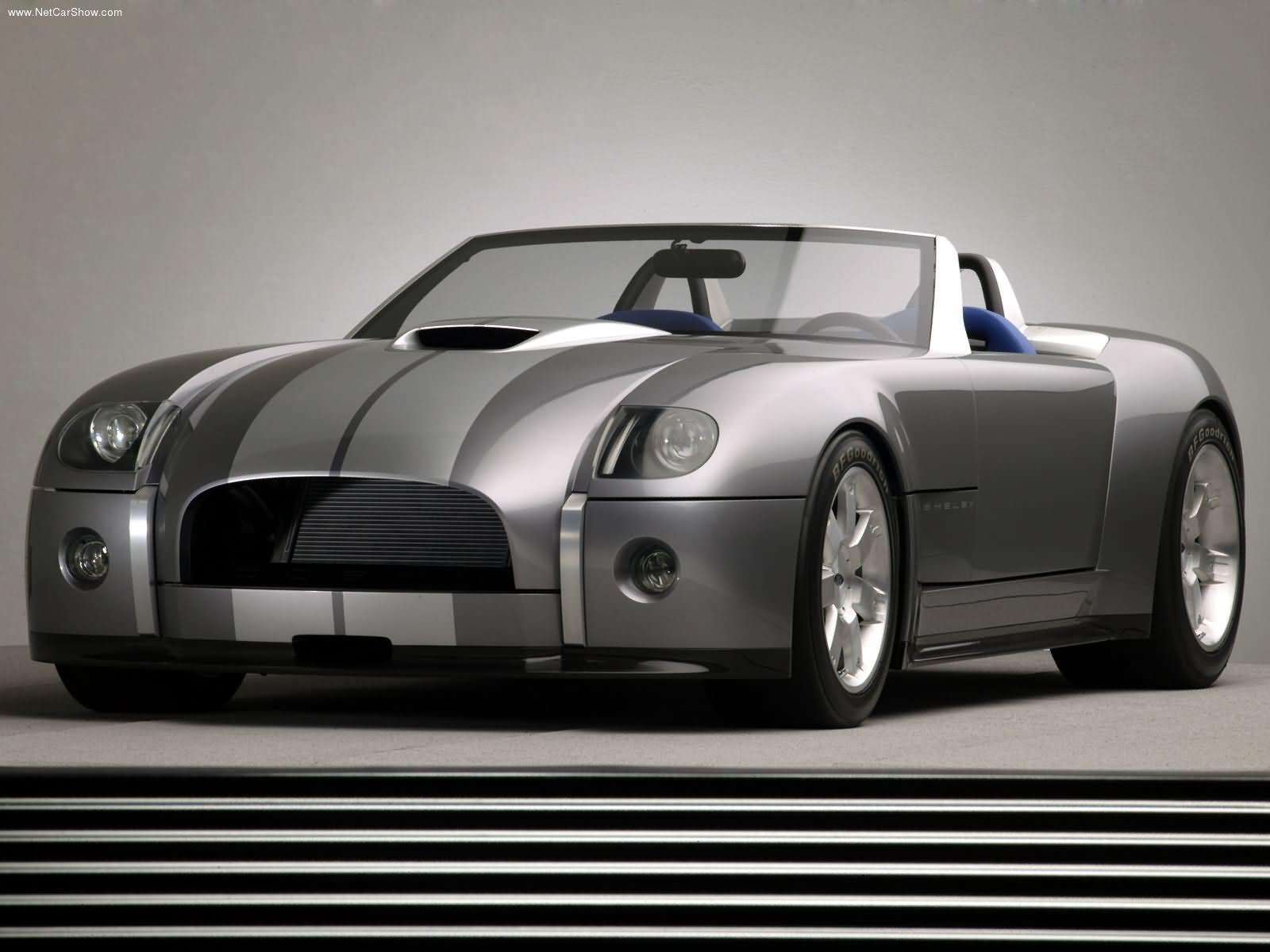


2005 Shelby Cobra Concept
Exciting evolution of Ford concept vehicles
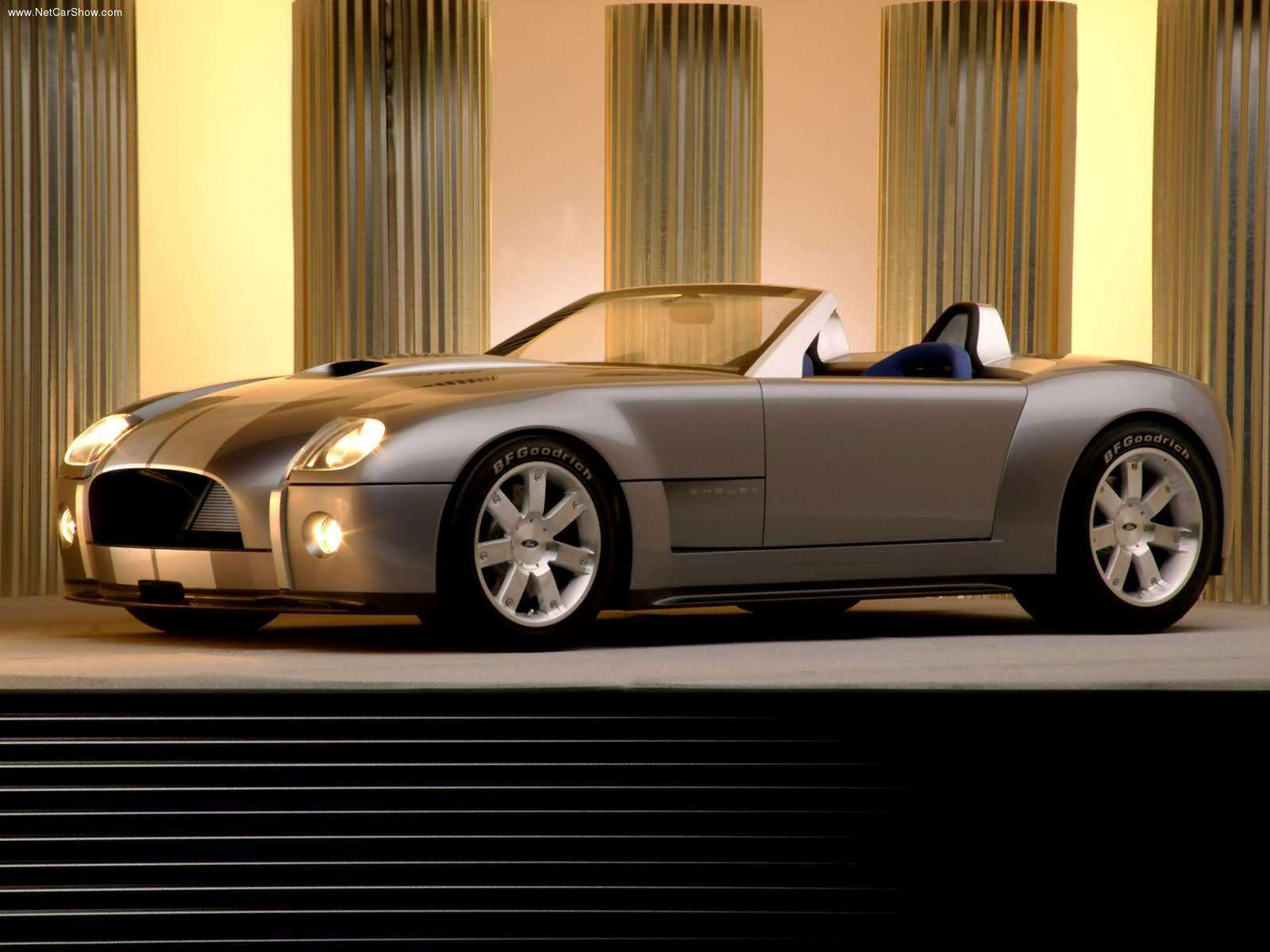
The new Ford Shelby Cobra concept marks the latest step in an exciting evolution of Ford concept vehicles, with an evocative design, bonafide performance credentials and – thanks to engineering as nimble and efficient as a sports car – a level of feasibility that is already close to production-level.
Like the 2002 Ford GT40 concept, the Ford Shelby Cobra draws on Ford’s emotional and performance roots in a thoroughly modern interpretation that reinforces the company’s product-led momentum. It takes its place with the 2005 Ford Mustang, Five Hundred sedan and Freestyle crossover in the “Year of the Car,” the largest new-product barrage in Ford’s history.
“Our lineup of new 2005 cars is all about momentum,” said Jim Padilla, executive vice president and president of the Americas, Ford Motor Company. “But the Ford Shelby Cobra concept is all about speed.”
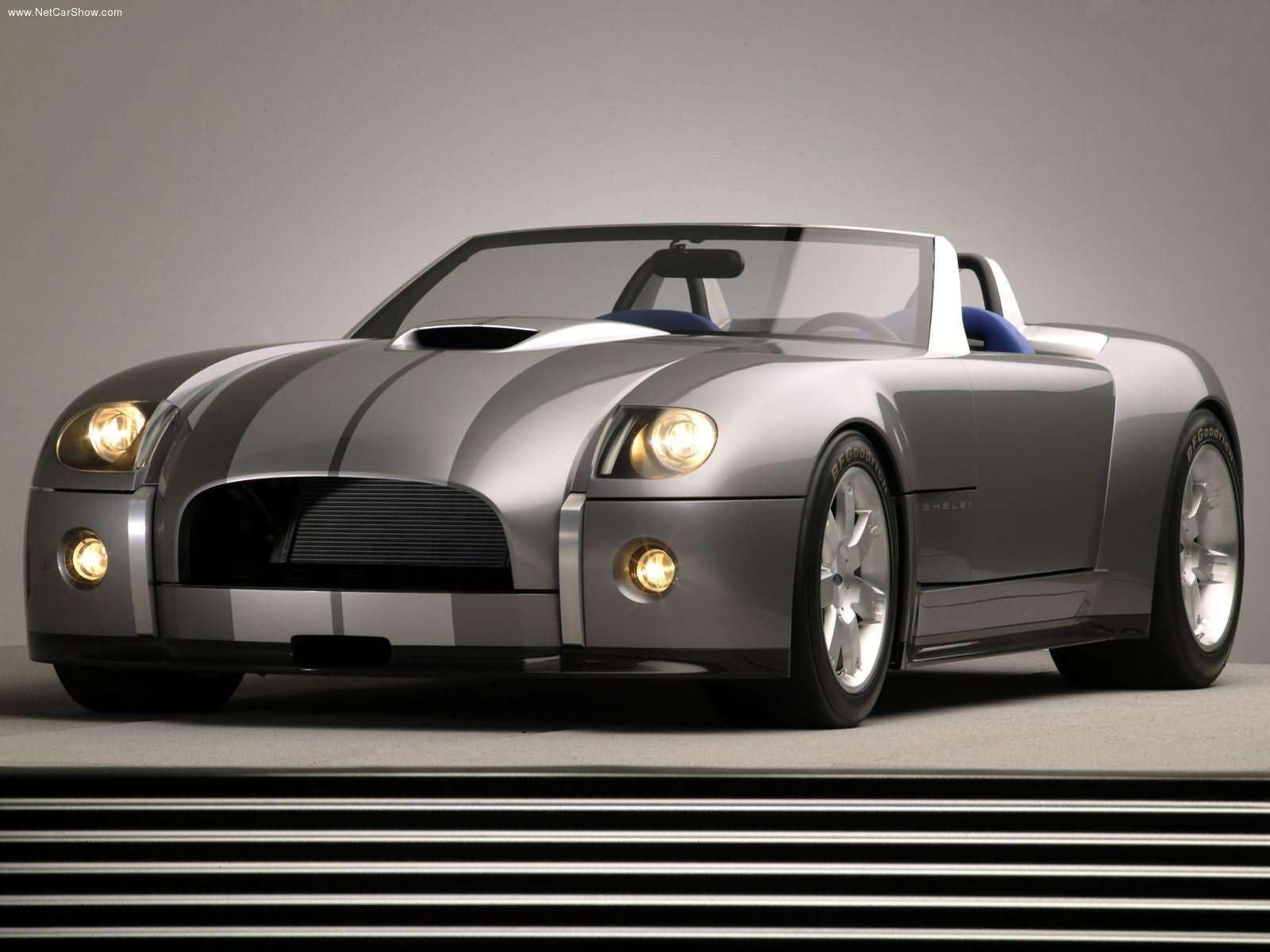
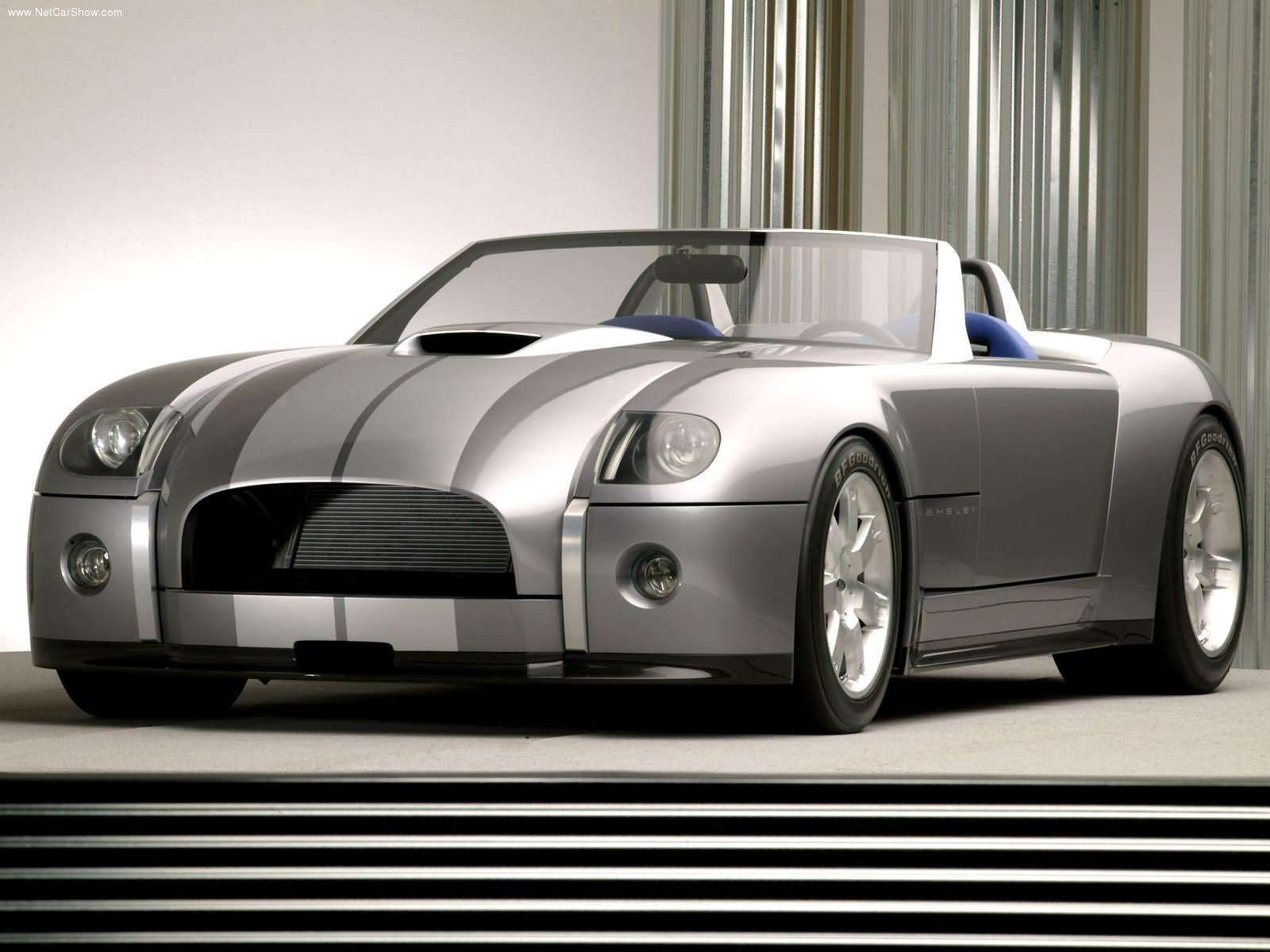
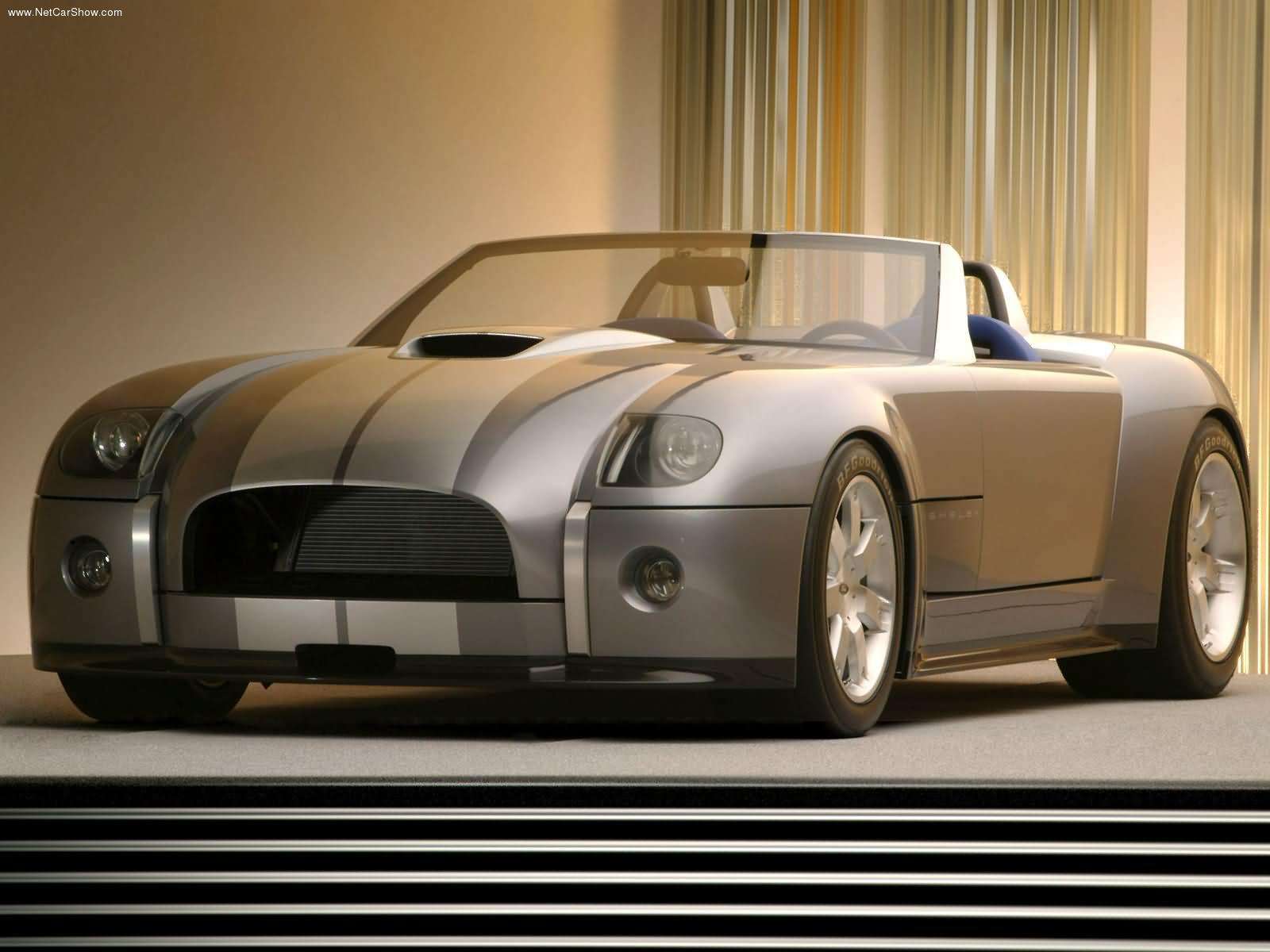
The Ford Shelby Cobra’s design reinforces this mission, with minimalist interior and exterior elements that emphasize its performance-oriented function. Cues like the massive grille opening, side vents, low-back seats and bulging wheel arches establish an emotional connection with Carroll Shelby’s original 1960s Cobras, but no dimensions or proportions are copied in this thoroughly modern two-seater.
The Ford Shelby Cobra concept team drew heavily on the Ford GT production car – especially the space frame and suspension – to maximize efficiencies. Although the cars have vastly different characters and different dimensions, smart engineering quickly adapted the rear-mid-engine Ford GT platform to this front-mid-engine application.
Inspired by the biggest, baddest Cobra of all – the renowned 427 – Ford engineers created a new aluminum-block V-10 to power the Ford Shelby Cobra concept. This 6.4-liter engine, adapted from Ford’s MOD family, delivers the rush of raw power associated with that big 1960s V-8 monster – with 605 horsepower and 501 foot-pounds of torque – without the aid of supercharging or turbocharging.
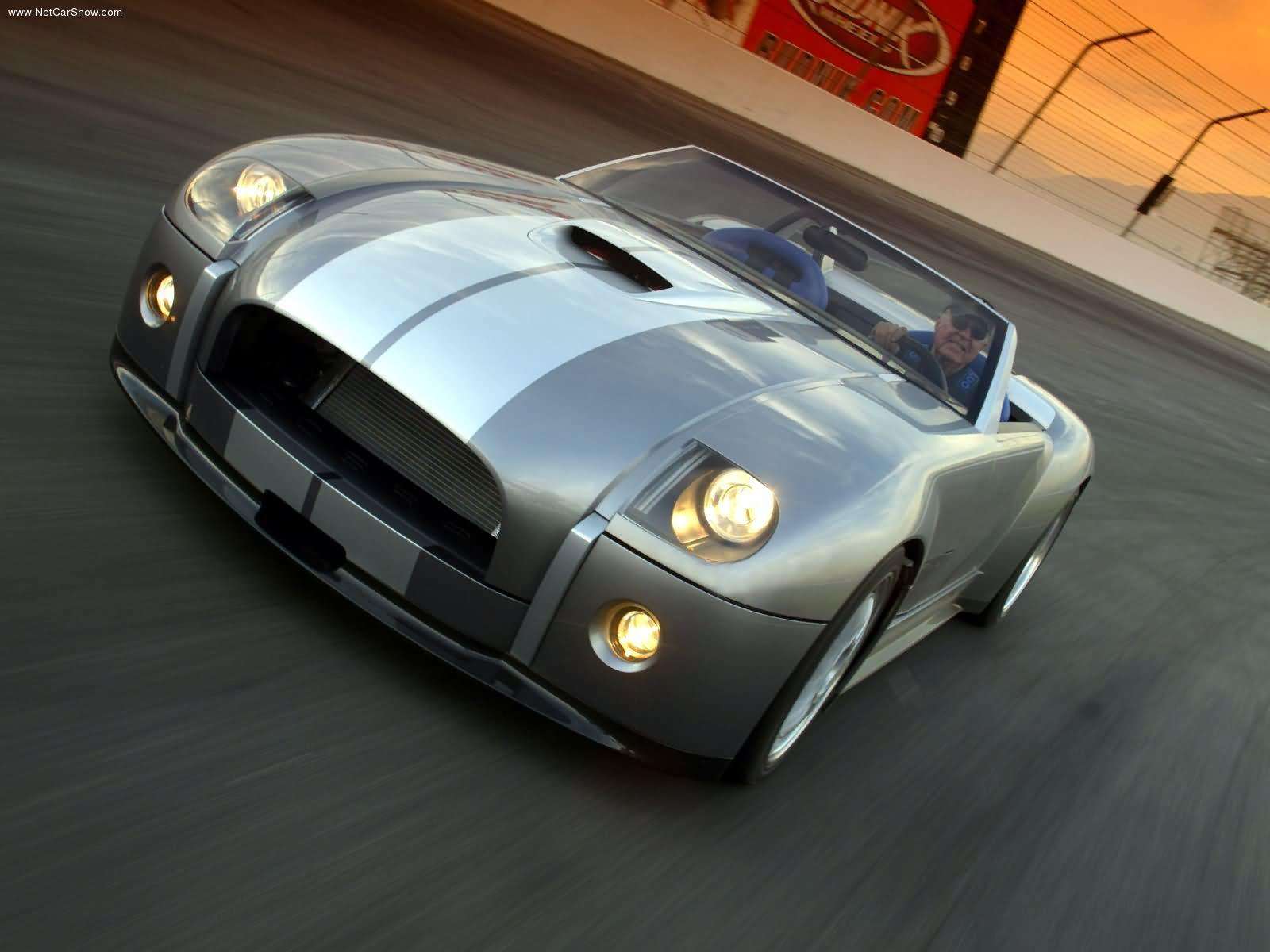
This combination of brute force and thorough engineering has created a rarity in the world of auto shows – a concept car that can actually do, rather than merely promise, zero to 60 in under four seconds, and would easily exceed 100 mph if not electronically limited. With show cars typically limited to a stately 15 mph or so, this fact points at the level of engineering packed into the Ford Shelby Cobra concept – and points to the authenticity that comes from working with Carroll Shelby once again.
“I’m sure the question on everyone’s mind at this point is, ‘Are you going to build a production version?’ The answer is, ‘We’ll see.’ If we get the same overwhelming reaction to the Cobra concept as we did to the GT concept, anything is possible,” said J Mays, group vice president, Design.
A New Legend is Born
As the saying goes, too much power is almost enough. So thought Carroll Shelby when he shoe-horned a 427-cubic-inch Ford V-8 under the hood of a small British roadster, giving birth to the legendary 427 Cobra.
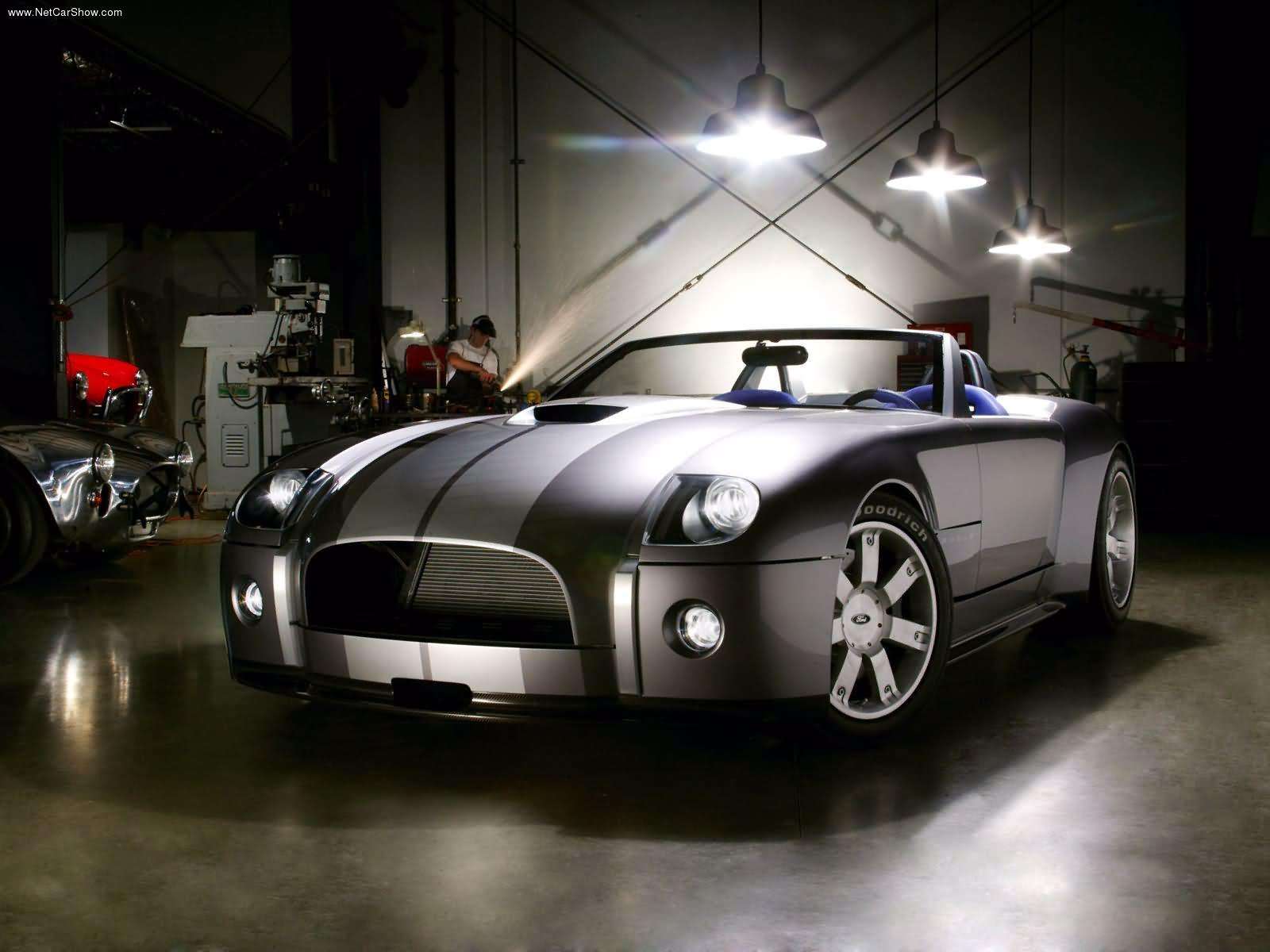
Four decades later, Ford’s Advanced Product Creation team – an in-house think-tank cum skunk works – explored the idea of applying Shelby’s famous formula to the latest components and architectures Ford has to offer. The result is the Ford Shelby Cobra concept, a radical new roadster, fully engineered for high-speed testing, completed in just five months by a small, tightly focused team of enthusiasts.
This production-feasible roadster has a 427-inspired 605-horsepower, all-aluminum V-10 engine mounted at the front of an advanced aluminum chassis modified from the rear-engine Ford GT.
It weighs slightly more than 3,000 pounds and is about as long as a Mazda Miata. There’s no roof, no side glass, not even a radio. “That’s the formula,” said Carroll Shelby. “It’s a massive motor in a tiny, lightweight car.”
Highly Evolved Engineering
The Ford Shelby Cobra concept is not just a huge engine with a pair of seats along for the ride. Owing to its front engine and rear transaxle layout, the roadster has nearly perfect weight distribution and a world-class supercar suspension for agility to match its alacrity.
What’s more, this ultimate roadster seats full-size adults without compromise. It actually has more front-seat legroom than a Ford Crown Victoria sedan. This key packaging achievement wouldn’t be necessary on a typical show car – but is absolutely essential to demonstrate production feasibility.
“We put together the mechanicals of a world-class supercar in a compact roadster package that can seat full-size adults,” said Manfred Rumpel, manager, Advanced Product Creation. “And we did it in just five months on a budget smaller than that for many nonfunctional, nonengineered show cars.”
The secret to the team’s success was Ford’s stepped-up efforts toward commonality, speed and the expertise of a team of engineers who had previously completed the all-new Ford GT in just 15 months.
“With the Ford GT, we now have a collection of supercar components,” said Chris Theodore, vice president, Advanced Product Creation. “We also have a team of engineers who know how to work fast to get the job done.
“It can take a year to build a concept car that doesn’t even run or is speed-limited to 15 mph,” Theodore said. “But in five months, we built one that will do 100 mph on the racetrack today.”
Evocative, Modern Design
Honoring the Cobra heritage is a fully modern architecture with subtle styling cues that hint at the legendary Cobras of the 1960s.
“What we’re trying to do is not just take the audience somewhere they haven’t been in a very long time, but take them somewhere they’ve never been – and there’s a lot of magic in trying to do that,” Mays said.
First and foremost, the Ford Shelby Cobra concept is a performance car, and every surface and line has its roots in the car’s engineering mettle.
“The powertrain, the space frame and the suspension were all key elements in the design, although for the most part, you don’t see them,” said Richard Hutting, chief designer. “These established our proportions and naturally led to a race-bred shape that evokes the original Shelby Cobra, without sharing a single dimension or proportion. Just like its underpinnings, this car is thoroughly modern in every way.”
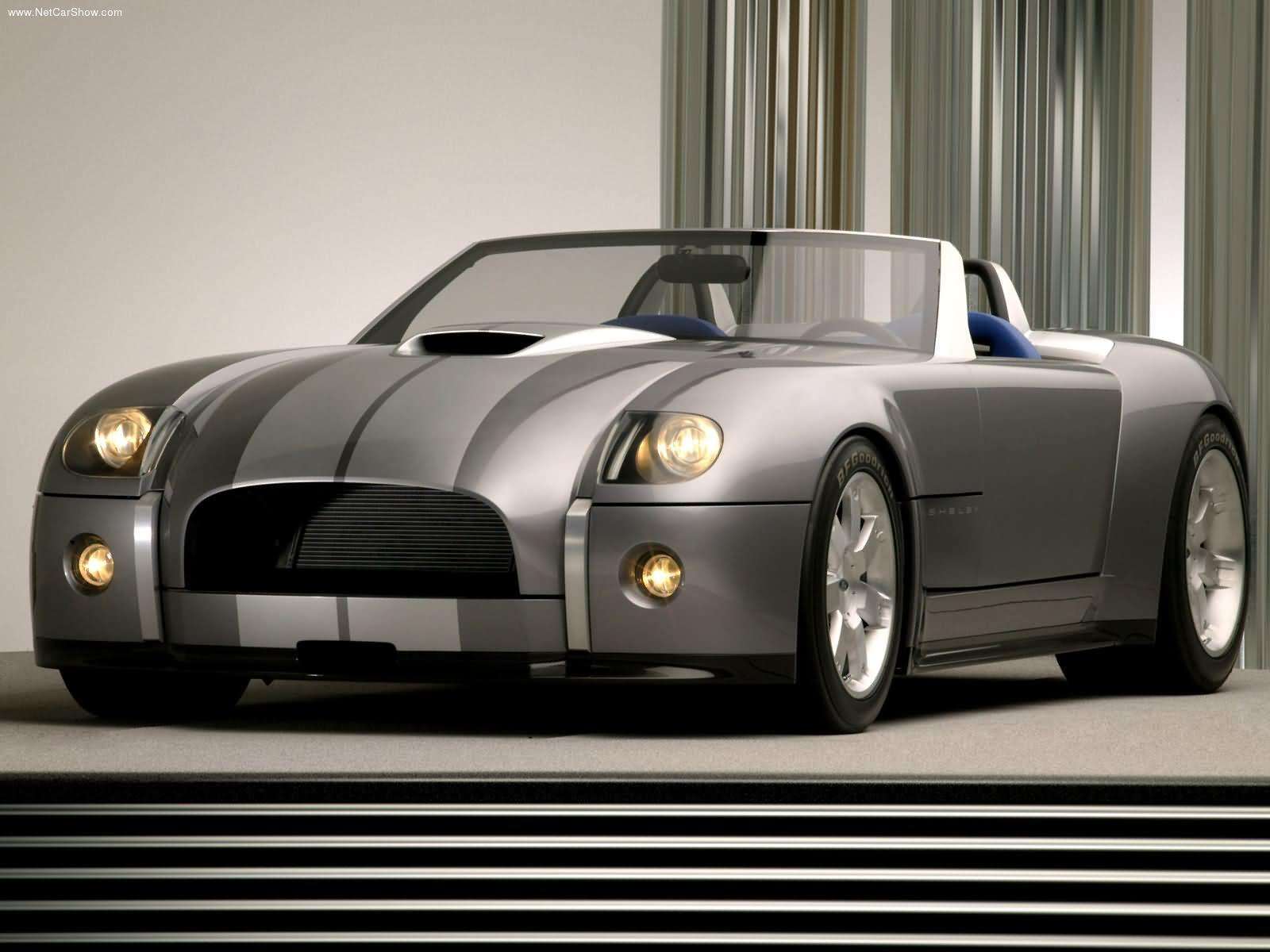
While the design is clearly 21st century, the roadster is intentionally familiar. Key details – the dominant grille opening, hood scoop, vertical bumper bars and stacked lamps front and rear – establish the historical connection to Shelby’s original creation.
“When you’re setting out to tell a story about an automobile in a fresh, contemporary way, you’re not actually looking to create beauty – you’re looking to create meaning,” said Mays. “We have interpreted that raw, aggressive Cobra attitude in a very modern way.”
The Ford Shelby Cobra concept completes the trilogy of Ford’s greatest performance vehicles: the GT40, Mustang and Shelby Cobra. It heralds a new era of speed from Ford, the company that best knows and most loves performance cars.
Ford And Shelby: Partners At The Finish Line For More Than Four Decades
Carroll Shelby’s role in the program was more than that of a spiritual leader. “As soon as we decided to build the Cobra, J Mays and I went to talk with him,” Theodore said. “Carroll has been involved every step of the way.”
Shelby’s presence at every management review provided authenticity, as well as real contributions to the program. For example, he and Theodore independently hit on the breakthrough idea of the rear transaxle.
It might shock many young racing hopefuls today to learn that Shelby didn’t enter his first automobile race – a quarter-mile drag meet – until he was nearly 30 years of age. What’s no surprise, of course, is that the hot rod Shelby drove to the finish line that day in 1952 was powered by a Ford V-8.
Shelby may have started late, but he was a winner from the beginning. Just two years into Shelby’s driving career, Aston Martin’s racing manager, John Wyer, recruited him to co-drive a DB3 at the Sebring endurance race. Within months, the chicken farmer from Texas was bumping elbows and trading paint with the likes of glamorous grand prix drivers Juan-Manuel Fangio, Phil Hill and Paul Frère. He won Europe’s prestigious 24-hour endurance race at Le Mans in 1959, driving an Aston Martin DBR1 with Roy Salvadori.
Early in 1962, Shelby drove his second Ford-powered race car. It was the first mockup for the Cobra, Shelby’s now-legendary marriage of a lightweight British roadster body with a small-block Ford V-8. By January 1963, he had homologated the car under the FIA’s GT III class rules and was lapping Corvette Stingrays at Riverside Raceway in Southern California.
In January 1965, Ford hired Shelby to lend his expertise to the upstart GT40 campaign. While Ford and Shelby took on Ferrari at Le Mans with the GT40, and won, they continued to fight Corvette at home with the Cobra. Production of the vehicle, which had a 1-ton weight advantage over the Corvette, began in June 1962 and continued through March 1967.
The first 75 Cobras that Shelby built were powered by Ford’s 260-cubic-inch V-8; 51 more had the larger and far more powerful 289.
Shelby first installed the Ford “side-oiler” 427 engine in the Cobra in October 1963, but the combination of this powerful engine and the rear leaf-spring suspension made the car treacherous to drive. Ford helped Shelby completely redesign the chassis, including an all-new coil-spring rear suspension, and by January 1965, Shelby introduced the production 427 Cobra – the car many enthusiasts herald as the ultimate street-legal racer.
“Our original objective was to build a sports car that would outrun Corvette,” Shelby said. “I never dreamed it would become the icon that it did.”
Specifications
- Vehicle Type – Open-top V-10 roadster
- Powertrain and Chassis
- Chassis construction – Welded and bonded space frame of cast and extruded aluminum
- Dimensions (in inches unless otherwise noted)
- Wheelbase – 100.0
- Overall length – 155.4
- Overall width – 75.0
- Track width, front – 60.6
- Track width, rear – 60.4
- Front legroom – 45.4
- Curb weight – 3,075 pounds (target with production-level bodywork)
- Engine
- Type – 6.4L, 90-degree V-10
- Configuration – Aluminum engine block and cylinder heads
- Redline – 7,500 rpm
- Valvetrain – DOHC, 4 valves per cylinder
- Intake – Velocity stacks with sliding plate throttles
- Bore x Stroke – 3.66 x 3.70 in / 93.0 x 94.0 mm
- Displacement – 390 cu in / 6,392 cc
- Compression Ratio – 10.8:1
- Horsepower – 605 @ 6,750 rpm
- Torque – 501 lb-ft @ 5,500 rpm
- Drivetrain
- Layout – Mid-front engine, rear transmission, rear-wheel-drive
- Transmission
- Type – Ricardo 6-speed transaxle
- Gear Ratios – Theoretical top speed at redline
- 1st – 2.60:1 – 64 mph
- 2nd – 1.70:1 – 98 mph
- 3rd – 1.23:1 – 135 mph
- 4th – 0.95:1 – 175 mph
- 5th – 0.76:1 – 219 mph
- 6th – 0.63:1 – 267 mph
- Reverse – 3.14:1
- Final Drive – 3.36:1 limited slip
- Suspension
- Front – Unequal-length aluminum control arms, coil-over monotube shocks, stabilizer bar
- Rear – Unequal-length aluminum control arms, coil-over monotube shocks, stabilizer bar
- Steering
- Type – Rack-and-pinion with power assist
- Ratio – 17.0:1
- Brakes
- Front – 14.0 x 1.3 in. (355 x 32 mm) Brembo cross-drilled and vented discs, four-piston monoblock calipers
- Rear – 13.2 x 1.3 in. (335 x 32 mm) Brembo cross-drilled and vented discs, four-piston monoblock calipers
- Tires and Wheels
- Front – P275/40R18 BF Goodrich racing tires on 18 x 10-inch BBS wheels
- Rear – P345/35R19 BF Goodrich racing tires on 19 x 13-inch BBS wheels
Powertrain & Chassis
At the time Carroll Shelby began his Cobra project in 1962, England’s AC Cars had a beautiful little open-top car that needed an engine. Ford had the industry’s best family of V-8 engines. Shelby saw the possibilities and brought the two together. The rest is history.
“The Ford engines turned out to be a great choice,” Shelby said. He first tried the 260- and 289-cubic-inch Ford small block V-8 engines before settling on the massive 427 as the ultimate Cobra engine.
For the next chapter in the Cobra legend, the modern Ford team also had a few powertrain options. They included the supercharged 5.4-liter V-8 from the Ford GT, as well as turbocharged 4.6-liter and 5.4-liter mills. Outstanding engines, yes, but they didn’t pack the spiritual punch of Shelby’s overpowering Ford 427.
They needed something more, something that would capture the essence of that 427 in a modern roadster. They found it in a satellite Ford engineering operation devoted to developing new powertrain technologies away from the narrower demands of product development.
In an atmosphere that is part think-tank and part speed-shop, the Advanced Powertrain team develops technologies that frequently have as many applications on the race track as in consumer vehicles.
For approximately two years, they had been working on an all-aluminum V-10 targeted at ultimate, naturally aspirated performance. When they bolted this beast into a Mustang chassis for evaluation, it only took one drive to confirm its potential.
“The Ford Shelby Cobra concept just begged for this engine,” said Graham Hoare, director, Ford Research and Advanced Engineering. “Although it’s not yet ready for production, we’ve reached a credible engineering level for such a serious concept car – and it has a modern soul that matches the famous 427.”
Blending the Advanced Powertrain team’s work with elements from the 4.6-liter, 4-valve V-8 used in the 2004 Mustang Mach 1, the resultant Ford Shelby Cobra concept engine has 10 cylinders and is bored and stroked for a 6.4-liter displacement, or about 390 cubic inches. It produces 605 horsepower at 6,750 rpm and 501 foot-pounds of torque at 5,500 rpm without supercharging or turbocharging.
“In many ways, it’s not very exotic,” said Hoare. “It uses the same basic castings and assembly techniques as our production modular engine family. The output, though, is phenomenal. If you can’t get in trouble with this kind of power, you’re not trying hard enough.”
Kevin Byrd, the V-10 project leader, thinks of the Cobra V-10 as an all-star combination of current Ford engine technologies. “This engine is an amalgam of everything right about Ford engines. We took the best that the modular engine family has to offer, then added some tricks of our own. The V-10 is a culmination of 100 years of building engines,” he said.
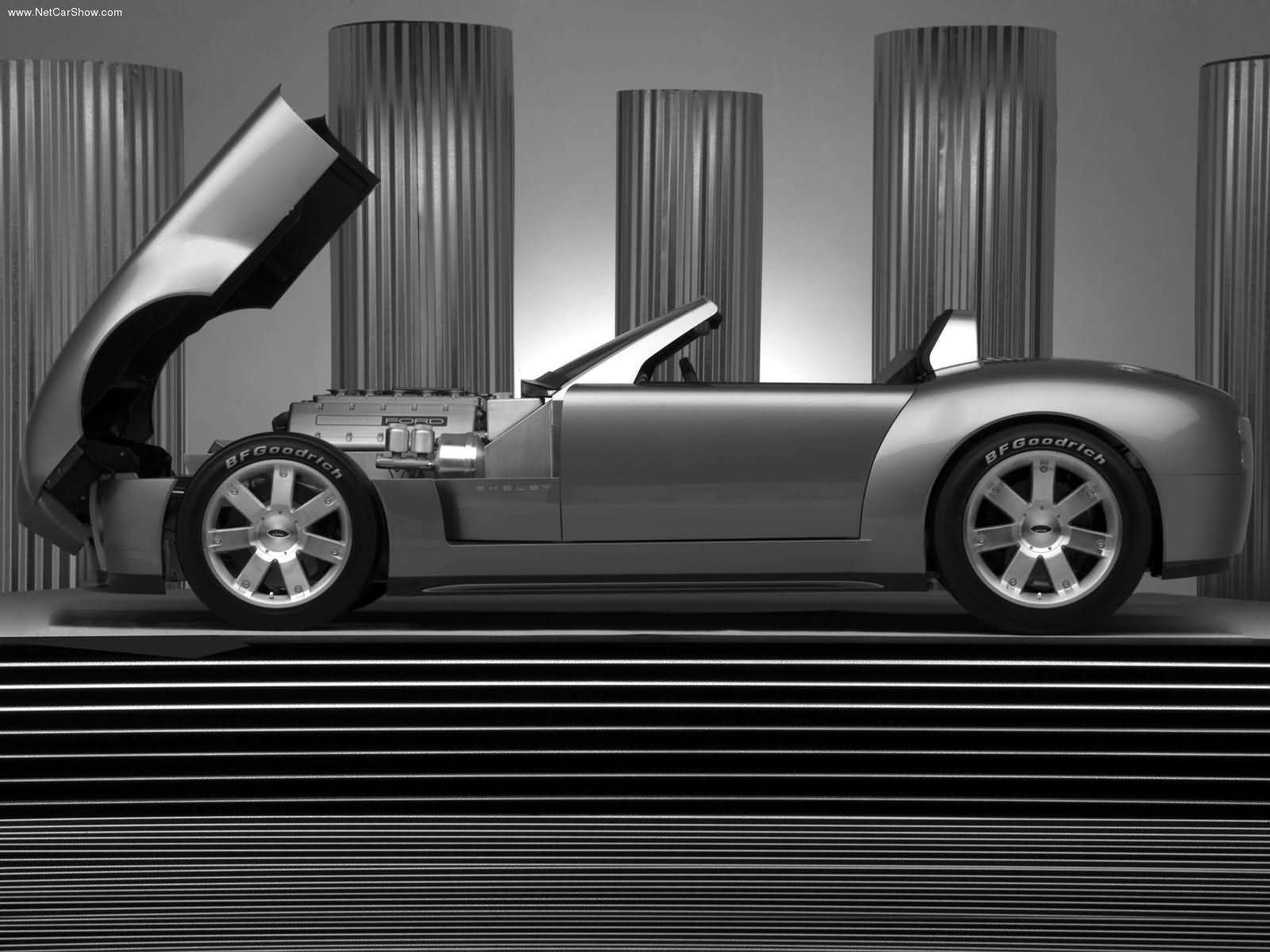
The double-overhead-cam cylinder heads and cylinders are fed by port fuel injection and racing-derived velocity stacks that are just visible within the hood scoop. For a low hood line, the throttles are a slide-plate design and the lubrication system is the dry-sump type, which relocates oil from underneath the engine to a remote tank. The engine proudly wears brushed aluminum “Powered By Ford” valve covers.
The rear-mounted six-speed transaxle is identical to the high-performance unit in the Ford GT, with an integral limited-slip differential to drive the rear wheels. Based on the engine’s 7,500-rpm redline and the drive ratios, this Ford Shelby Cobra concept has a theoretical top speed of more than 260 mph and would break 130 mph in third gear, although it’s electronically limited to 100 mph – for now.
Front-Mounted Engine and Torque Tube
One of the challenges of fitting a 10-cylinder engine into a compact roadster is leaving room for the driver’s legs and feet. With a conventional transmission mated to the back of the engine, the tradeoff between hood length and passenger room often makes for a cramped footwell and dramatically offset pedals – a flaw of the original Cobras and many modern sports cars.
Because the Ford Shelby Cobra concept was planned from the outset to be a production-feasible “runner,” not just a pretty show car, the team had to address the legroom concern. They found that mounting the transmission at the rear of the car, connected to the front-mounted engine with a torque tube, let them use a very narrow “tunnel” between the seats.
Compared to a conventional driveshaft, which is typically mounted behind the transmission, a torque tube-style driveshaft spins considerably faster because it is running at engine speed. The spinning inner shaft is supported within a stationary outer tube that stabilizes the engine and transmission in bending and in torsion. The inner shaft taps crankshaft torque via a twin-disc, small-diameter clutch mounted at the rear of the engine.
Computer-aided design was essential in helping the first prototype come together smoothly. “Because they spin so much faster than driveshafts, these torque tubes can be a nightmare in terms of vibration,” said Manfred Rumpel, manager, Advanced Product Creation. “Using our electronic tools, we optimized the location of the driveshaft support bearings, and it ran smoothly on the very first try. This type of modern engineering tool gives us a development advantage that pioneers like Carroll Shelby could only dream about.”
Although the AC Cars 260 roadster was the starting point for the original Cobra, the Ford Shelby Cobra concept team had no obvious existing architecture suitable for the project.
“We knew we wanted a front-engine car that had to be ultra-compact and lightweight, yet robust enough to handle 605 horsepower,” said Theodore. “There was nothing that fit the bill on first glance.”
But Rumpel’s team saw a creative solution.
“We were already planning to use the Ford GT suspension systems, and we asked ourselves how much more of the GT we could borrow,” he said.
Quite a lot, as it turns out. Even though the GT is a mid-rear-engine car, and the proposed roadster was to have a front engine, a decision to mount the transmission at the rear made the connection.
“Once we really started looking into it, we had an epiphany,” Theodore said. “The project took on a new sense of purpose when we really started leveraging the Ford GT engineering.”
The team worked long hours with John Coletti, head of Ford’s Special Vehicle Team, to maximize the commonality. Fresh from completing the all-new Ford GT in just 15 months, Coletti understood what it took to build fast cars faster than ever. “It was a great team effort,” Coletti said.
The bulk of the rear structure is made from slightly modified Ford GT components, including the massive, trellis-like cast aluminum suspension nodes, the rear rails and bumper beam, a major cross-member and the brackets used to mount the transmission.
The center portion of the space frame also has a high degree of GT commonality–major aluminum extrusions are based heavily on existing pieces. At the front of the roadster, the team incorporated the extruded main rails, steering rack cross-member, crash-management sections and the bumper beam.
“The concept car was even assembled using the prototype jigs the GT team no longer needed,” said Rumpel. “This commonality and re-use goes hand-in-hand with our speed and cost efficiency.”
Overall, the Ford Shelby Cobra concept is more than 2 feet shorter than the GT, with a wheelbase nearly 7 inches shorter. Even the track width has been reduced by more than an inch. That the concept car and the GT share any parts at all is a testimony to the flexibility of the space frame design and the creativity of the chassis team.
To attach the massive 18- and 19-inch wheels and tires to the car, the team chose to use the Ford GT suspension system with a few modifications to accommodate the increased weight up front. Like engine technology and electronics, suspension design has come a long way in more than 40 years.
“The original leaf-sprung Cobras were awesome on the straightaway but didn’t make a name for themselves in the turns,” said Rumpel.
Theodore was even more direct, “The original 427 was a beast.”
The new Ford GT earns praise for its combination of agility, grip and easy-to-drive character, a reflection of its sophisticated suspension design and the expertise of its chassis engineers. The Ford Shelby Cobra concept applies the best of the GT suspension to a big-engine roadster.
A double-wishbone suspension design with unequal-length aluminum control arms, coil-over monotube shocks and stabilizer bars is used front and rear. The upper control arms are identical at all four wheels and are made with an advanced rheo-cast process that allows the complexity of form associated with casting, yet retaining the strength of forging. The metal, heated to just below its melting point, is the consistency of butter when it is injected into a mold at high pressure. Pressure is maintained as the part cures, preventing porosity in the final product for exceptional strength.
The steering rack also is borrowed from the Ford GT, with a few modifications. The steering column, like the Ford GT’s, draws on Ford engineering best-practices like the low friction, high stiffness and light weight that have made the Ford Focus steering column among the best in the industry. Braces between the front shock towers and below the isolated engine mounts improve torsional rigidity and aid steering response.
With more than 600 horsepower available at the throttle pedal, the brake pedal had to be equally potent. The team set braking distance targets comparable with today’s best sports cars, and turned to the Ford GT braking system for suitable components.
Brembo “monoblock” one-piece aluminum brake calipers with four pistons each grab cross-drilled, vented discs at all four wheels. The discs are a massive 14 inches in front and 13.2 inches in the rear, for fade-free stopping power. But the team stopped short of fitting the car with an antilock braking system, in keeping with its racing character. Brake balance is biased slightly to the front wheels to aid stability.
For packaging reasons, the team devised a novel offset actuation linkage for the brake booster and master cylinder, so the brake pedal can be placed in a normal position even though its hardware is off to the side of the engine bay.
The one-piece BBS wheels are wrapped by BF Goodrich Z-rated racing slicks, size 275/40R18 in front and 345/35R19 in the rear.
Design
The Ford Shelby Cobra concept, like the legendary 1960s original, features a utilitarian body tightly wrapped around a race-bred engine and chassis. Every surface and line has its roots in the car’s uncompromised performance.
“We let the powertrain, the space frame and the suspension dictate the architecture for the body,” said Richard Hutting, chief designer.
“The result was a very authentic, modern and desirable shape that does justice to the original Shelby Cobra, but doesn’t share a single dimension or proportion with it.”
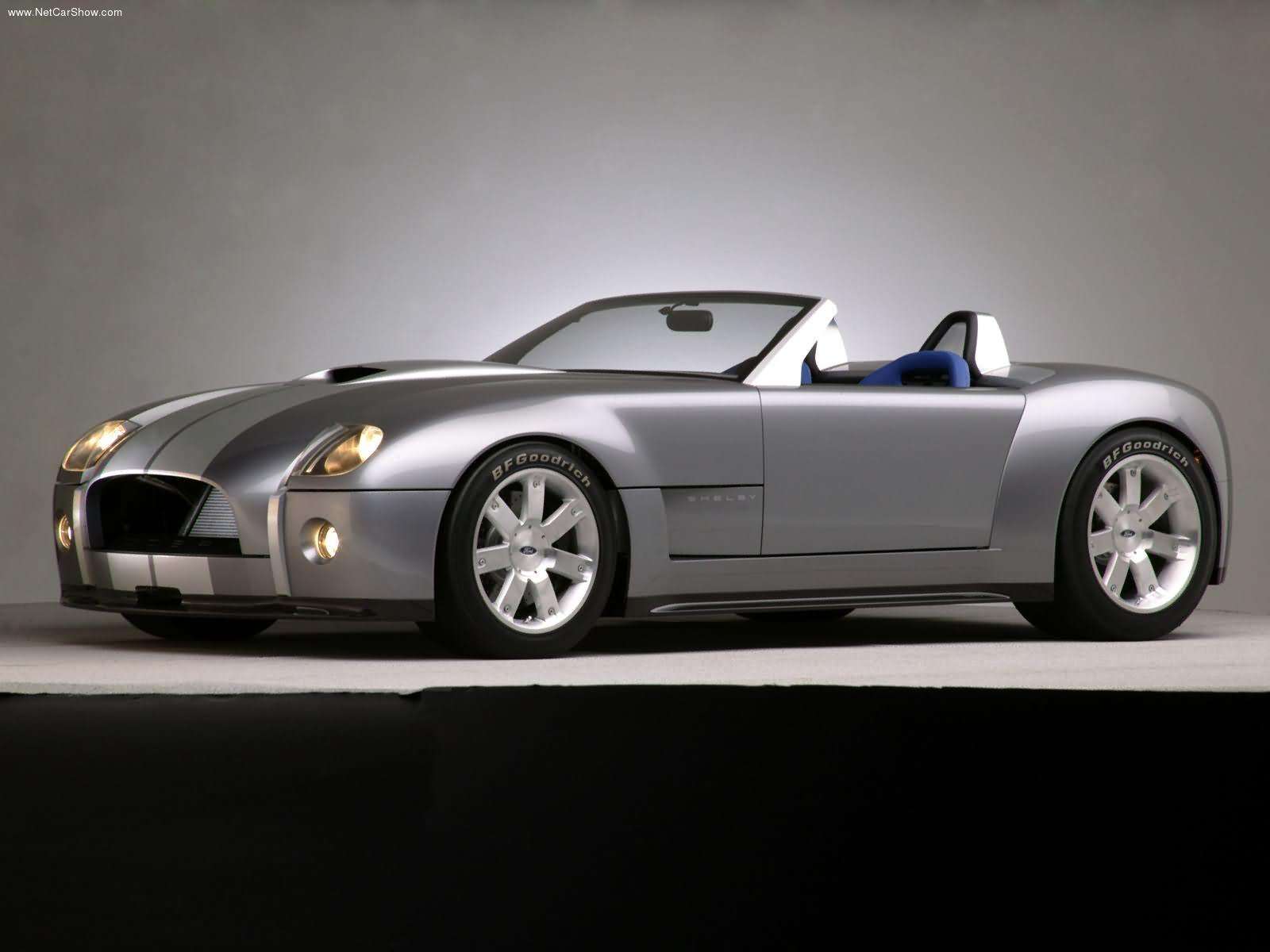
Through key design details – the dominant grille opening, vertical bumper bars, stacked lamps front and rear, side air extractors and, most importantly, the powerful bulge over each rear wheel – the historical connection to Shelby’s original creation is undeniable.
While Ford Design is known for its modern interpretations of legendary vehicles – the Ford GT, Mustang and Thunderbird, to name just a few – it also leads the industry in innovative ways to carry people and cargo.
From the Model A to the first Mustang, to the world’s most versatile sport utility vehicles, Ford has a history of packaging efficiency, and the Ford Shelby Cobra concept is no exception.
A key engineering decision – to mount the concept’s six-speed manual transmission at the rear of the car – enabled designers to give the car almost 3 inches more legroom than similar competitors’ performance vehicles, while providing nearly perfect weight distribution.
“From a package perspective, the rear-mounted transmission and the small-diameter, twin-plate clutch made for a larger foot space than typically possible in such a small car with a large engine. This 10-cylinder, 605-horsepower, all-out sportscar has more legroom than in a Ford Crown Victoria sedan,” Hutting said. “We also didn’t have to compromise the driving position by offsetting the pedals – an important consideration in a performance car.”
Performance elements help to define the exterior, as well. Because the engine sits rearward of the front wheels, the front overhang is extraordinarily short. An equally brief rear overhang gives the Cobra concept a 100-inch wheelbase – longer than that of a Dodge Viper, but with a head-to-tail measurement that is more than 20 inches shorter. In fact, the front and rear overhangs are both shorter than on the 1965 Shelby Cobra – the rear considerably so.
These proportions place the Ford Shelby Cobra concept into a league of its own among production-feasible vehicles, communicating rear-drive power and serious performance.
The car’s stance on the road is unmistakably purposeful, with only 4.5 inches of clearance between the carbon-fiber chin spoiler and the pavement. From the rear, powerfully bulging wheel arches embrace the massive 19-inch rear wheels, signifying that that’s where the power comes to the ground.
Just as designers used the mechanical package to drive the Ford Shelby Cobra concept’s proportions and attitude, they drew from the car’s racing persona to create a clean, unembellished “wrapper” for the powertrain and chassis.
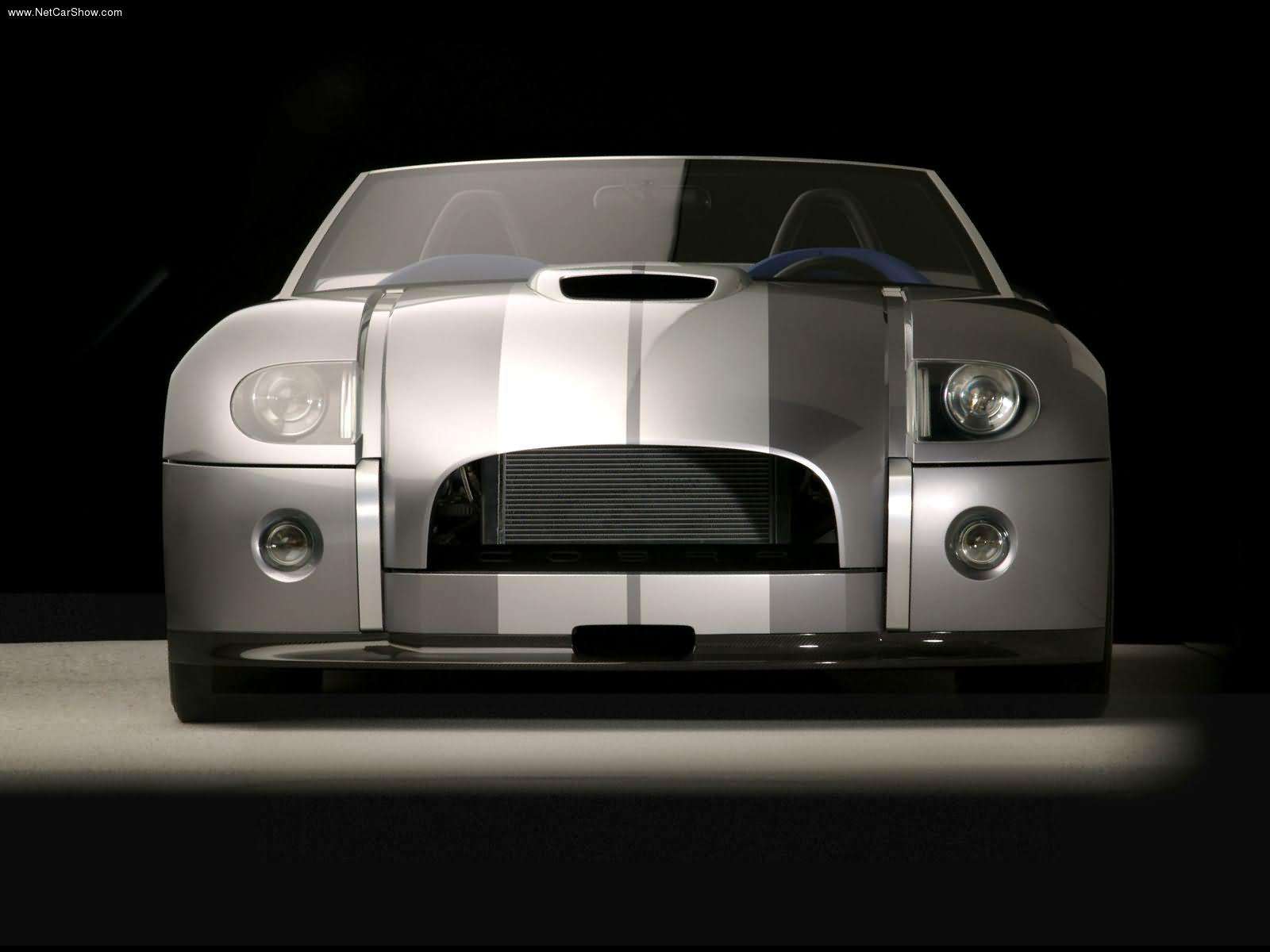
The front section of the body is a forward-tilting “clamshell.” This simple design provides immediate, wide-open access to the powertrain and front suspension while defining the clean hood profile. Prominent design elements include the oversized grille opening for the radiator and the chin scoop below it for the oil cooler.
The headlamps and driving lamps at the front of the car are stacked vertically, as on the original Shelby Cobra.
“These lamps, combined with the vertical billet-aluminum bumper bars, the grille opening and the muscular fenders, are the way the front of the concept communicates ‘Cobra,’ ” Hutting said.
In character with the Ford Shelby Cobra concept’s uncompromised performance, there are no windshield wipers, no side windows and no convertible top – it is a fair-weather-only racing machine.
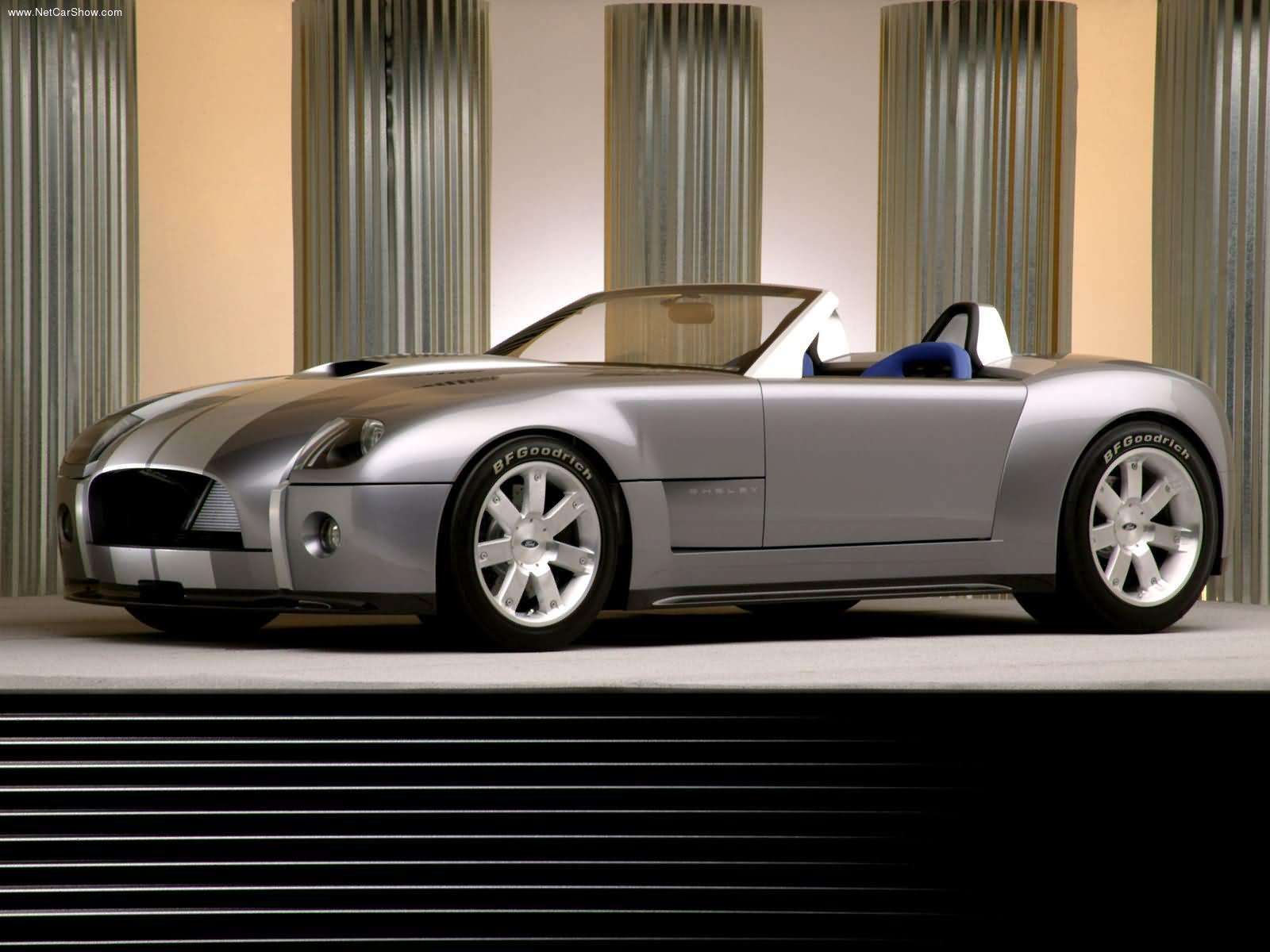
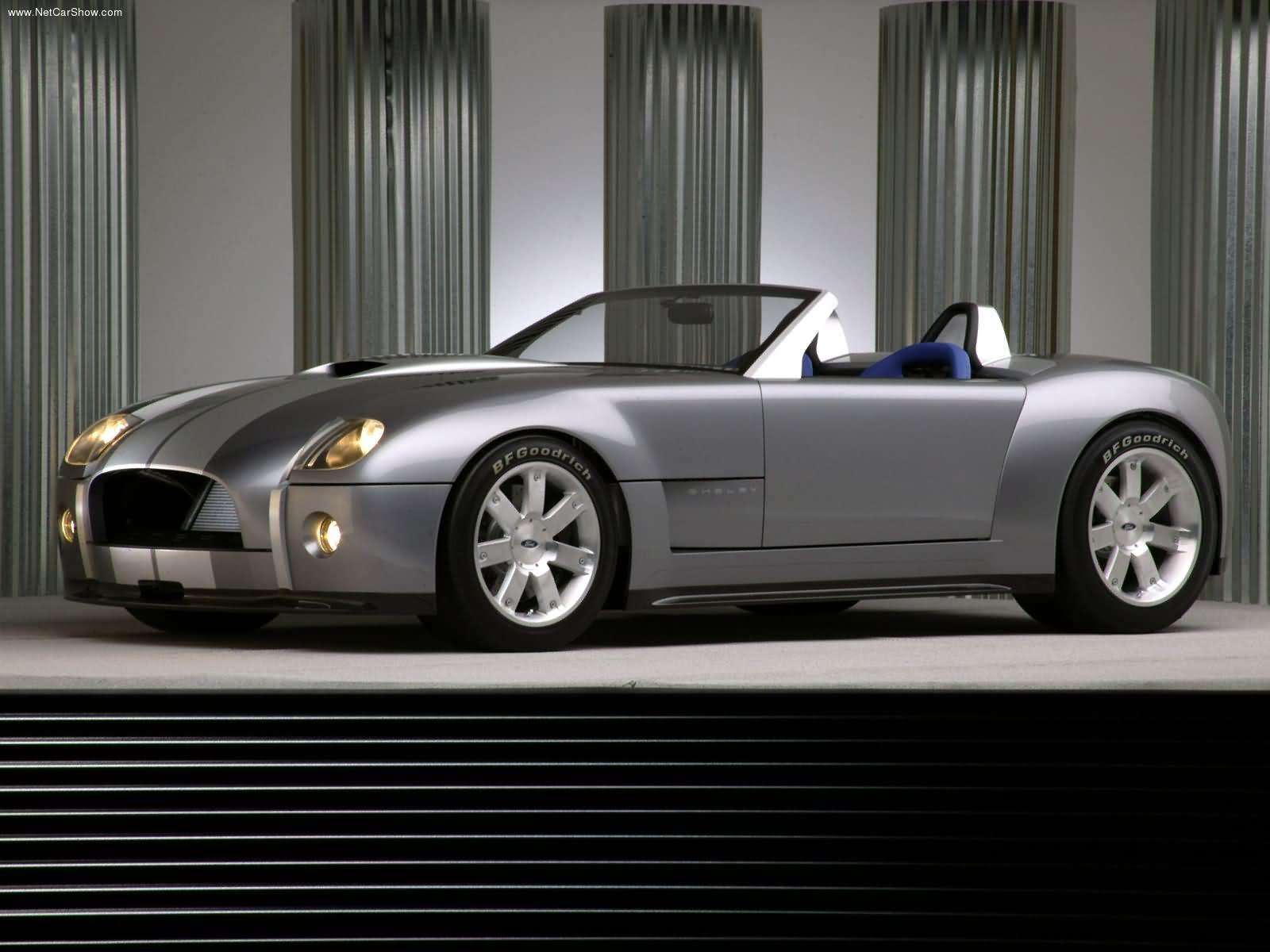
The sides of the body are pure function. Just aft of each front wheel is a prominent rectangular air extractor – to cool the engine and the brakes – and a conventional forward-swinging door with a dramatically simple shut line that terminates at the rear fender. To emphasize the clean body sides, designers also omitted door handles.
The decision to forgo exterior door handles left the team with a quandary: How do you open the doors? They briefly looked at incorporating an electronic button but settled on the original, elegantly simple Cobra solution of placing the inside handle up high, where it can easily be reached from outside the car.
“It’s a race car,” Hutting said. “The driver would rather reach inside to open the door than carry the weight of two more handles.”
Aluminum A-pillars and dual roll hoops behind the low-back seats are modern touches that expose the advanced aluminum space frame while echoing the form and function of the classic chrome roll hoops used on some original Cobras.
In keeping with its racing mission, the Ford Shelby Cobra concept does without side mirrors in favor of a higher-tech, lower-drag design. A trio of video cameras – mounted high in each A-pillar and at the center of the windshield frame – create real-time color images that are displayed on a digital version of the traditional center-mounted rear-view mirror. The images from each camera are stitched together on this liquid-crystal display to form a perfect 180-degree panorama of the competition.
A mere 27 inches of rear overhang (measured from the axle line to the bumper) and other rear design details further develop the themes of uncompromised performance and Cobra heritage.
Benefiting from four decades of aerodynamics research, the Ford Shelby Cobra concept departs from the original car by incorporating carbon-fiber “barge boards” to manage air extraction from the side vents, and a carbon-fiber diffuser in the rear to create downforce. These aerodynamic aids borrow heavily from wind tunnel lessons learned with the Ford GT and Formula 1 racing and were devised and tested with the aid of computational fluid dynamics software.
The rear transaxle cover is left exposed and becomes a design element that conveys mechanical strength.
Small, stacked round taillamps and vertical billet-aluminum bumper bars subtly trace their bloodlines back to the original Cobra.
“Even within the very modern framework of the short overhang and exposed underbody aero effects,” Hutting said, “the rear of the car has Cobra cues to connect it to the legend.”
A bright, Tungsten Silver metallic paint reinforces the car’s mechanical precision, while twin stripes in a lighter shade of silver run fore and aft over the hood and rear deck, in a nod to Shelby’s traditional race car stripes.
Seven-spoke BBS racing wheels were chosen for strength and light weight. Dramatically larger than the 15-inch wheels of the original Cobra, they measure 18 inches in front and 19 inches at the rear. The wheels wear lower profile rubber all around – with the massive 35-series rear tires measuring more than 13.5 inches wide.
“When you see those massive tires under their bulging fenders and those exposed aerodynamic aids, you know at a glance that this is a serious racing machine,” Hutting said.
Purposeful Interior
Proving that a minimalist roadster also can be comfortable, the 605-horsepower Ford Shelby Cobra concept offers none of the traditional electric amenities, yet boasts more front-seat legroom than a Ford Crown Victoria sedan.
The rear-mounted transmission offers a huge advantage in interior packaging: The driver and passenger are positioned close together near the vehicle centerline and separated by a narrow driveline tunnel. The spacious foot wells are nearly rectangular, in marked contrast to vehicles where the transmission tunnel hump severely restricts the driver’s foot room on the right, or the front wheel intrudes on the left – or both. The Ford Shelby Cobra concept driving position is comfortable and ergonomic, with an adjustable steering column.
The carbon-fiber racing seats with five-point belts offer support for high-performance driving. Their low-back profile – a nod to traditional sports cars – is made possible because the roll hoops behind the seatbacks are padded to double as head restraints. This allowed designers to capture the old-school feeling of the original Cobra seats in a thoroughly modern execution.
The cockpit is trimmed in aluminum, with electric blue splashed on the seat trim and steering column.
A full-width aluminum instrument panel spans the cockpit in one unbroken swath – a throwback to the true “dash boards” of yesteryear and a contrast with today’s driver-centric cockpits. Instruments include a 220-mph speedometer, 10,000-rpm tachometer and critical temperature and pressure readouts.
There is also a fuel pump switch, an under-hood fire-suppression system release and an emergency master kill switch to comply with racing rules.
What’s missing? “There’s no audio system at all,” Hutting said. “The tuned exhaust makes its own music.”
Pictures