

Los Angeles, Nov. 28, 2006 – The 2005 Ford Mustang captured the hearts and minds of millions and sparked the imaginations of a pair of the world’s leading coachbuilders in Italy as well.
”When we saw the new Mustang, we knew two things: It was the best we’d seen since the original, and we had to get our hands on one,” said Fabrizio Giugiaro, styling director of Italdesign – Giugiaro S.P.A. “We still believe it’s important to show the automotive world pure exercises in style that interpret key models reflecting the history and image of important brands.”
So in early 2005, Giugiaro pitched J Mays, Ford Motor Company’s group vice president, Design and chief creative officer, on his idea to do an Italian job on the beloved Mustang. The result: Mustang by Giugiaro – a one-of-a-kind concept powered by Ford Racing technologies, marking the Italian coachbuilder’s first reveal at the inaugural November Los Angeles Auto Show.
Design aficionados will remember that the senior Giugiaro – who last year celebrated his 50 th anniversary in the business by designing a custom-made Ferrari, the GG50 – created the 1965 Bertone Mustang. The car, which was unmistakably Italian in its interpretation, became the first European-styled car to make its international debut in America following the end of World War II.
Since joining ItalDesign, the family firm, in 1990, Fabrizio Giugiaro has helped deliver key global designs as well, but American automotive icons have long captured his attention. He designed the Chevrolet Corvette Moray, unveiled in early 2003, and was eager to expand the collection of Giugiaro-interpreted American metal. Fabrizio Giugiaro led the 2-D design process on the Mustang by Giugiaro concept, allowing him to deliver a complete exterior model from the family’s Turin, Italy, studios in just four months.
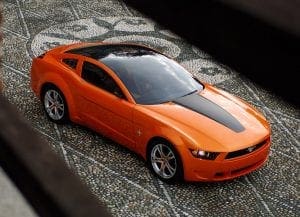
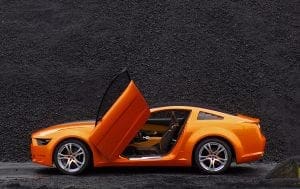
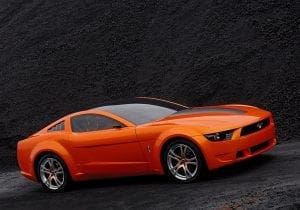
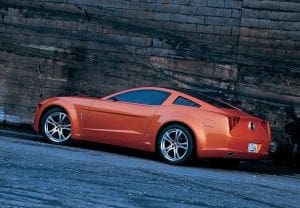
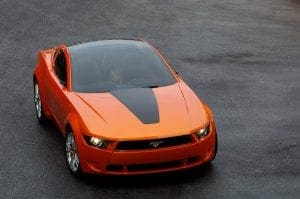
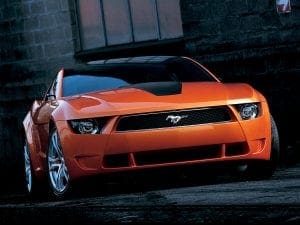
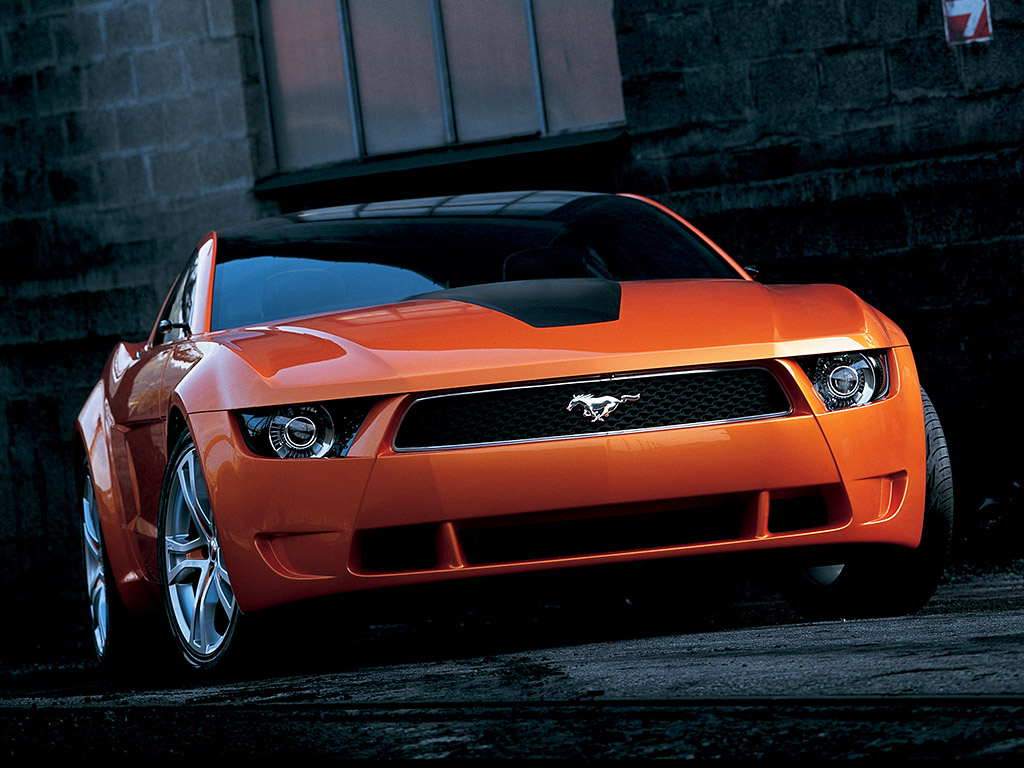
Visually, the Mustang by Giugiaro appears more compact than the production car, thanks to a reduction of the rear overhang and a signature Giugiaro trick of tapering the angles on the car to the limit of its mechanical outlines. Still, the Italian version of America’s most popular muscle car hasn’t lost any of its swagger.
The vibrant orange concept is wider than the production version. The Giugiaros added 30 millimeters to the front, gradually expanding the width by a full 80 millimeters toward the rear, which is typical in Italian design. With its longer hood and the trunk barely visible, the car looks more of a fastback in side view. But details throughout reinforce the freedom and rebellion synonymous with Mustang. Fabrizio Giugiaro’s favorites include:
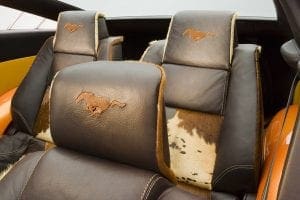
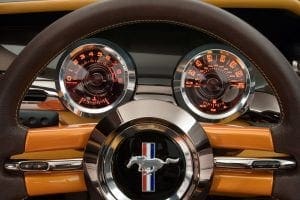
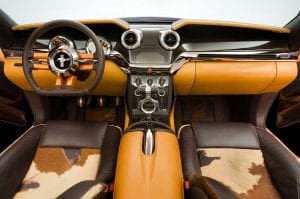
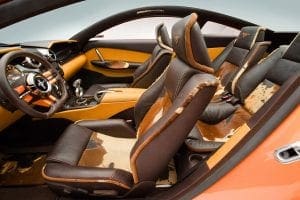
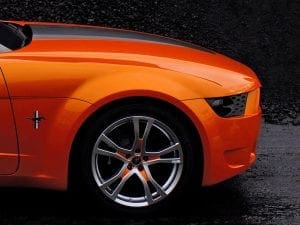
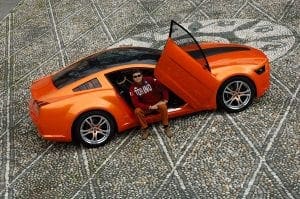
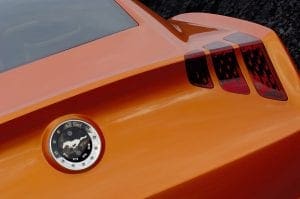
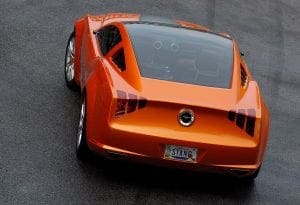
* The interior – featuring a dramatic instrument panel that sweeps the width of the car; circular gauges that project from behind the steering wheel; dark brown horsehide-covered headrests with horse logo accents; and seat cushions and backrests elaborately upholstered in dark brown mottled horse hides. * The single curved glass panel that bridges the windshield and rear window, serving as the concept’s roof. Produced by Solutia of Detroit, the panel is made from a special type of crystal that filters out 100 percent of UVA rays while providing unfettered vista views. * Its dramatic doors, which are hinged at the base of the upright A-pillar and open vertically at the touch of a button. * Bespoke taillights, which are three separate elements as found on the 1964 Mustang – but reinterpreted into a more dramatic arrow shape that links to the louver panels that replace the rear side windows. * The visible curl that sweeps into the crest of the concept’s carbon fiber fenders, hinting at tail fins that defined American cars of the ’50s. * The sporting-but-elegant unique 20-inch rims, fitted with 275/40 tires on the front and larger 315/35 tires on the rear.
Ford Racing improved on the already-robust 300 horsepower all-aluminum 4.6-liter 3-valve V-8 engine in the production Mustang GT by adding an intercooled twin-screw supercharger for the new concept. Additional improvements include fuel injectors from the Ford GT and a unique engine calibration. Engine air intake is increased with a larger 95 mm mass air meter and a conical air filter. Exhaust performance is enhanced with new Ford Racing mufflers and an X-pipe.
The powertrain upgrades deliver an estimated 500 horsepower, complete with a boost level of 11 psi from the Ford Racing supercharger. A high-efficiency Ford Racing aluminum radiator provides increased cooling capability to accompany the extra 200 horsepower provided under hood.
Under the car, the FR500C-inspired chassis tuning is accomplished with a tailored Ford Racing Handling Pack. This package, available through Ford Racing for the Mustang GT, adds new Dynamic-tuned dampers, lowering springs and anti-sway bars. The changes give the car a lower stance while sharpening handling response. The car rides approximately 1.5 inches lower than the production Mustang GT.
”The Mustang by Giugiaro drives as good as it looks,” said Fabrizio Giugiaro. “After taking it to the limits on streets outside of Turin, I can honestly say this car was well worth the 30,000 hours of blood, sweat and tears that we invested to create a modern performance classic.”