

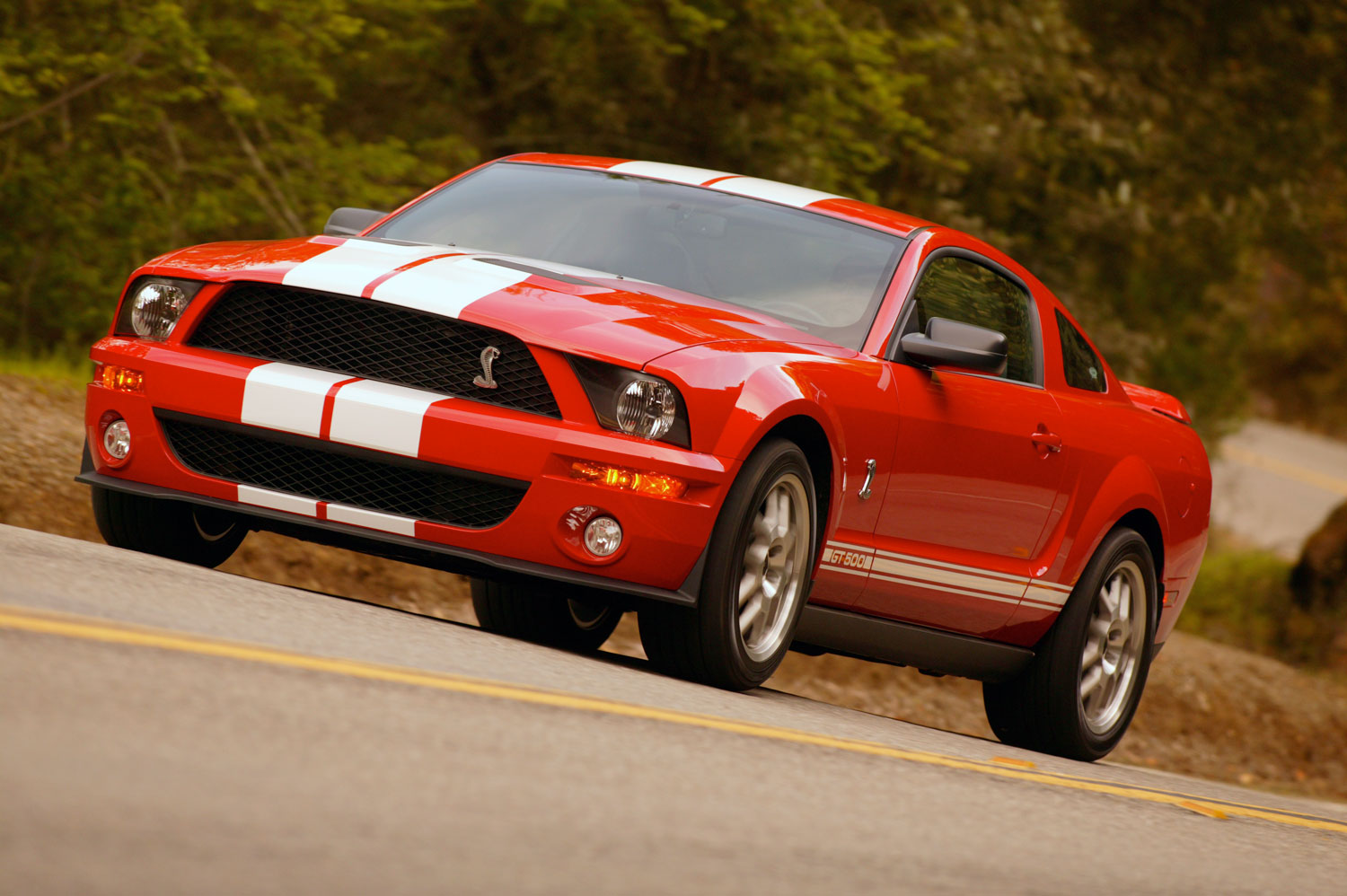

2007 Ford Mustang Shelby GT500
Thank You For the 5.4-liter Supercharged V8
After Ford Division mainstreamed Special Vehicle Team operations and entered into a new business relationship with Carroll Shelby in 2006, the car that SVT had engineered to be the all-new SVT Mustang Cobra came to market as the 2007 Ford Shelby GT500. Based on the all-new S197 Mustang platform and equipped with a special 500+ horsepower supercharged version of the 5.4-liter V-8, this modern-day Shelby GT500 took the muscle car world by storm with looks that mirror the classic’s and the kind of power and performance previously unheard of in any factory-built Ford Mustang.
The highlight of the first series of S197 Mustangs without a doubt is the 2007-2009 Shelby GT500; the most powerful production Mustang to ever hit the streets to that point. Originally, the GT500 was developed by Ford’s Special Vehicle Team (SVT) as a replacement for the awesome 2003-2004 ‘Terminator’ Cobra. Despite the folklore, the modern Shelby GT500 was much more a Ford and SVT product than it was a Shelby, with almost all the design and engineering work as well as production being SVT.
“When Carroll was developing the original GT350 and GT500, he wanted to build the most powerful, most capable Mustangs of his day,” says Hau Thai-Tang, director, Advanced Product Creation and Special Vehicle Team. “Our goal was to build the most powerful, most capable Mustang ever.”
Any Mustang with Shelby’s name on it is going to be a performance focused machine. The 2007 Shelby 500 didn’t break that promise we have all come to expect. Performance hardware included a 5.4 liter supercharged V8 with a great 6-speed manual transmission, race-tuned suspension and four-piston Brembo brakes. The 5.4-litre twin-cam 4-valve per-cylinder V8 produced 500 horsepower and 480 pound-feet of torque. The most powerful Mustang ever (at the time).
“It’s one thing to put 450 horsepower in an exotic supercar,” says Shelby. “It’s another to put that much power in something as affordable as a Mustang. The fact that they not only met their goal but pushed on to 500 horsepower is a remarkable achievement.”
The underlying work by the SVT team was extensive. With the lessons learned from the Terminator Cobra program SVT engineers stuffed the 5.4-litre iron block with a forged-steel crankshaft connected to forged-steel I-beam connecting rods and forged aluminum pistons. Bolted to the block are a set of aluminum cylinder heads sourced from the Ford GT supercar. These four-valve heads required some machining changes to the outside ends of the heads and to the left rear cam cap in order for them to fit into the Mustang’s engine bay. A set of camshafts from the Terminator Cobra were fitted to operate the valves. Finishing off the heads were a pair of valve covers finished in satin black with special “Powered by SVT” finned-cam covers.
An all-new low-profile lower intake manifold was installed that helped lower the overall height of the engine so that it could easily fit under the GT500’s hood. Attached to that manifold was a Roots-type supercharger capable of producing 8.5 pounds-per-square-inch of boost and a water-to-air intercooler used to cool the intake charge for maximum horsepower and torque. Air entered the supercharger through a 60-millimeter dual bore electronic throttle body.
Spent exhaust gases flowed through a pair of unique exhaust manifolds that helped to better scavenge gases out of the cylinders to a tuned stainless steel X-pipe and then through a dual-exhaust with twin custom tuned mufflers at the rear of the car.
Engine cooling was handled by a high-capacity aluminum radiator and an oil-to-water stacked dish engine oil cooler. Excess engine heat was also vented out through a functional air extractor hood.
Just as had been the tradition of the Cobras from the past decade all of the GT500 engines were hand assembled on the niche-line at Ford’s Romeo engine plant with each engine receiving a plaque singed by the team members who built the engine affixed to the left valve-cover. The 5.4-litre supercharged V-8 was the largest-displacement engine installed in a regular production Mustang since 1973 and with 500-horsepower it made the 2007 Shelby GT500 the most powerful factory-built Mustang ever.
To handle that thundering horsepower and torque, power was rooted through a heavy-duty Tremec TR6060 6-speed manual gearbox. The TR6060 was essentially an upgraded version of the T-56 6-speed transmission that saw duty in the 2000 SVT Cobra R and later in the supercharged Terminator Cobra. For the Shelby GT500 the TR6060 was geared to make the most of the 5.4-liter’s healthy power band. At the rear was a modified 8.8-inch gear-set with a 3.31:1 gear ratio with limited slip.
With 500 supercharged horsepower lurking beneath the hood, the GT500 required some upgrades to the suspension and brakes to keep the car on the road. Stiffer springs along with Tokico struts and shocks were installed that slightly lowered the car and sharpen the handling. Despite its bigger, heaver engine up front the GT500 still managed to corner relatively flat thanks to the use of stiffer stabilizer bars. Up front the GT500 used a 34-millimeter tubular stabilizer bar while at the rear coupe versions had a 24-millimeter bar and convertibles came with a 20-millimeter bar. For added body structure rigidity a strut tower brace was also part of the package.
Interestingly, the GT500 wasn’t equipped with an independent rear suspension as had been promised when the S197 Mustang had been introduced in 2005. SVT’s new boss, Hau Tai-Tang, who took over the reins at SVT after John Coletti’s retirement at the end of 2004, believed that the handling benefits would not justify the extra cost and customers would be hard pressed to notice the difference. Besides, there had been a small but very vocal group of old –school drag racing enthusiasts who were rather upset that the 2003 Cobra had been produced with an IRS as I had witnessed at a gathering of Cobra owners at SVT headquarters in the summer of 2003. While a well developed IRS would have brought the GT500 to the next level in regards ultimate track handling performance, the solid axle was acceptable for most driving situations on the street.
Although SVT didn’t go all the way with the rear suspension, that doesn’t mean the GT500 wasn’t a fun handling car as it felt crisp with its precise steering response. To achieve this, the steering gear was enhanced with a unique torsion bar and a special power steering pump was specified. Additionally a brace was added that connects rear lower arm bushings side to side.
To put the power down to the road the GT500 used staggered sized Goodyear Eagle F1 Supercar rubber mounted on 18×9.5-inch aluminum wheels. Tire size up front was P255/45ZR18 and a beefy P285/40ZR18 at the rear.
Hiding behind those massive wheels and tires was a set of Brembo front brakes with massive 14-inch rotors and huge four-piston calipers. At the rear, the GT500 still had the 11.8-inch vented rotors with single-piston caliper from the Mustang GT however a unique pad material was employed for better bite. Everything kept under control by a four-channel ABS system with a traction control that could be defeated with a push of a button.
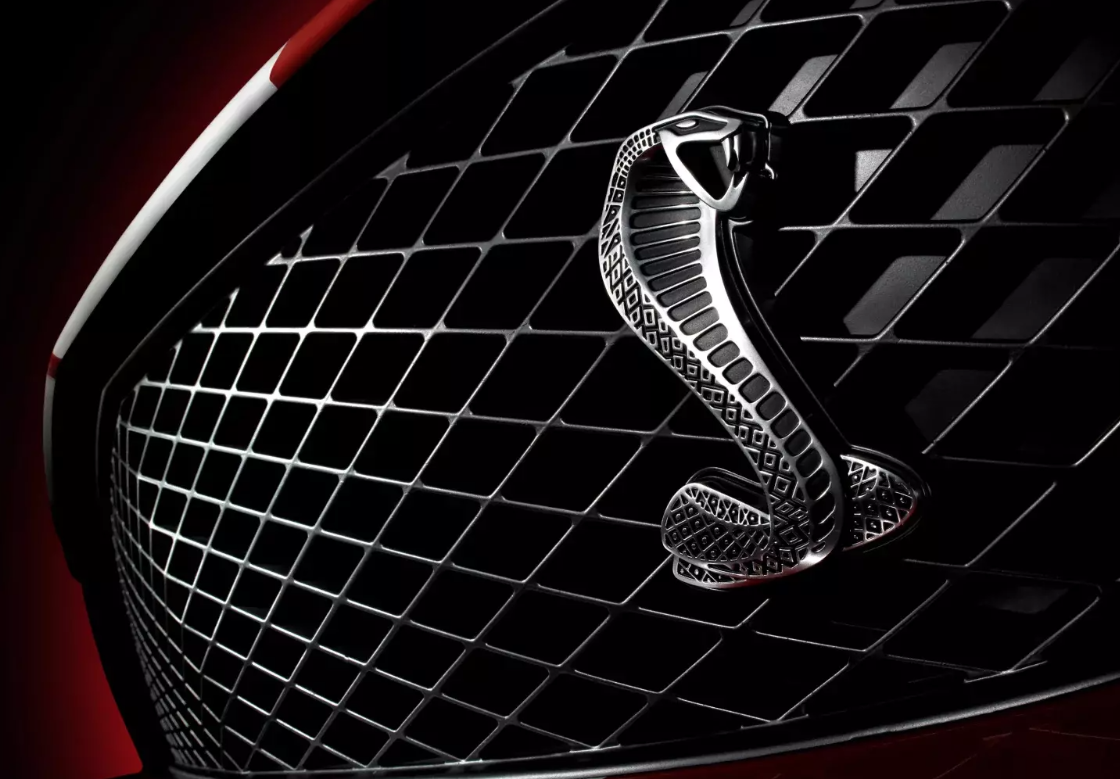
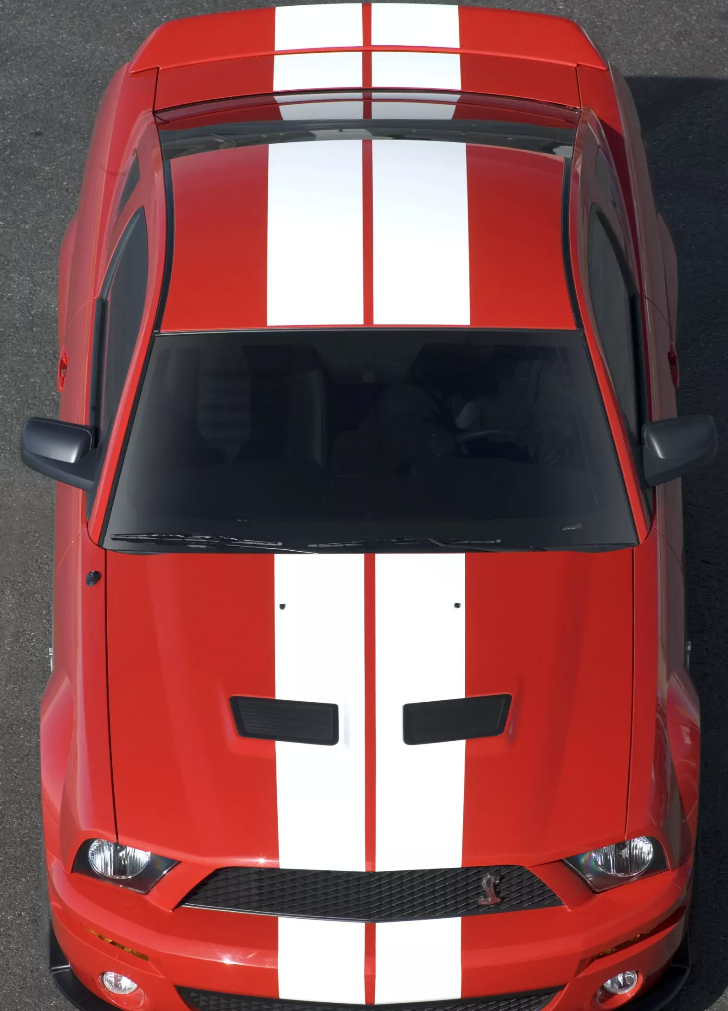
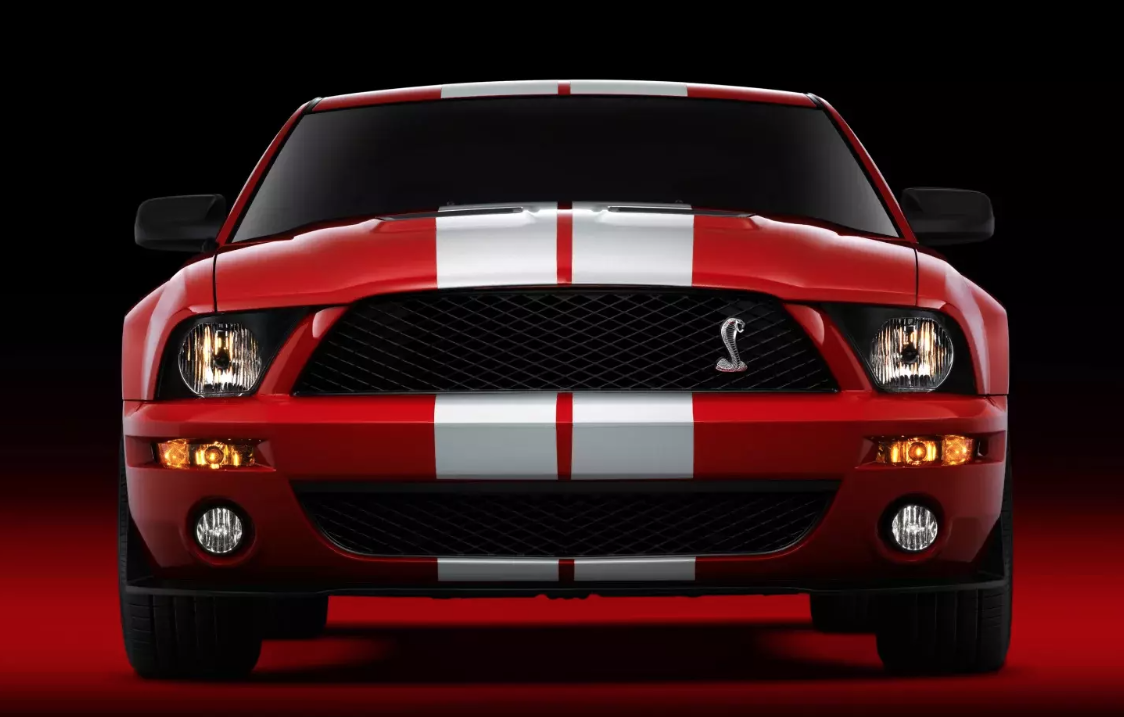
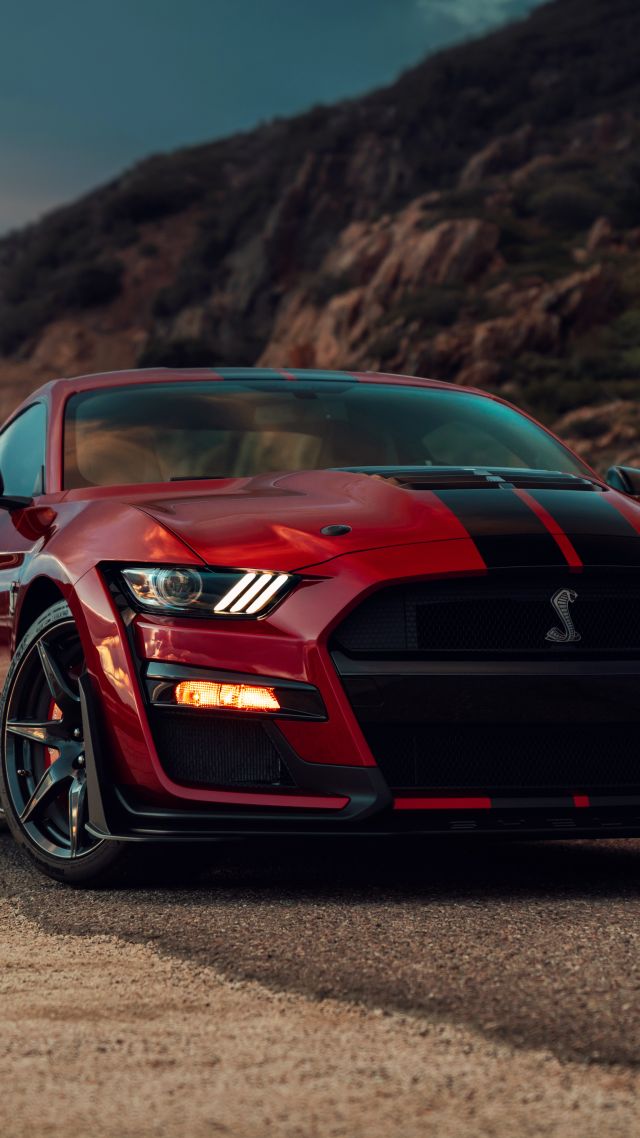
The exterior of the GT500 was treated to some unique styling cues and aerodynamic tweaks to make the car look more aggressive while standing still and more stable at high speeds. A new front fascia with a big mouth grille, round fog lamps below the turn signals and modest air splitter at its base gave the GT500 a menacing look while allowing much needed air into the engine compartment. A chrome snake insignia was installed on the left side of the grille that pronounced to the world that this was no ordinary Mustang. A powerdome hood with built in heat extractors near its leading edge, which allowed the heat from the monstrous blown 5.4 to escape was installed.
Wide Le Mans style striping was standard on the coupes but was curiously unavailable on the convertibles. Not to be made to feel left out by the lack of stripes convertible owners were treated to a premium cloth convertible top similar to the one installed on the 2003 and 2004 Cobra. Either body style wore the traditional Shelby rocker-panel stripes with GT500 script. If the buyer wanted a more modest looking GT500 there was an option to delete either or both sets of stripes. Another pair of forward facing coiled snakes adored the front fenders making it clear that this Mustang meant business.
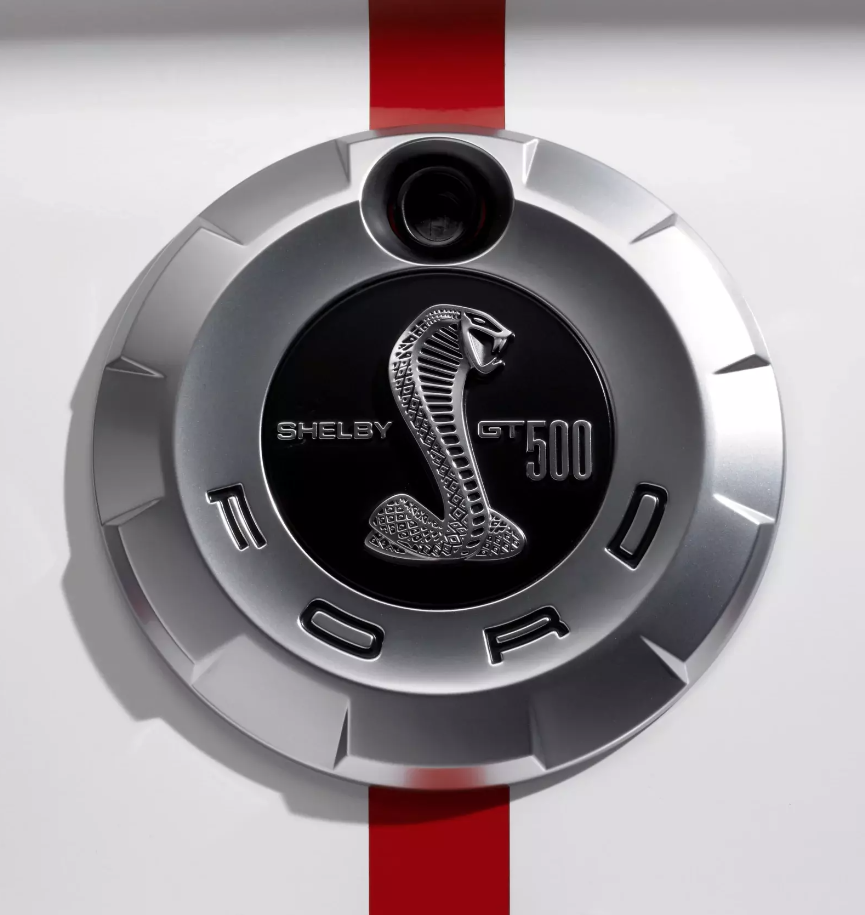
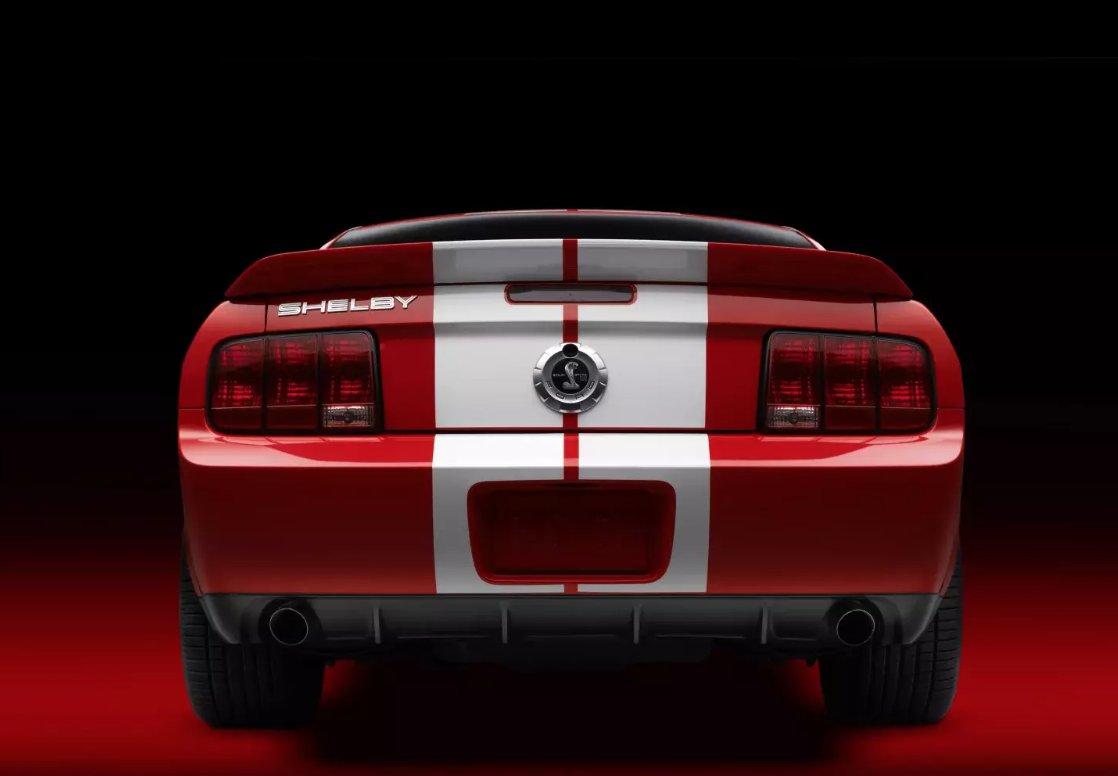
At the rear, an air diffuser below the rear bumper, similar to the one installed on the California Special, was installed. Affixed to the deck lid was a carefully shaped ducktail spoiler that was designed to optimize high-speed stability. The deck lid also wore large “SHELBY” block lettering and the faux fuel-filler cap was redesigned with a coiled snake and “Shelby GT500” lettering. The look of the GT500 was aggressive and menacing without being over-styled or over the top. With the stripe delete it was particularly stealthy.
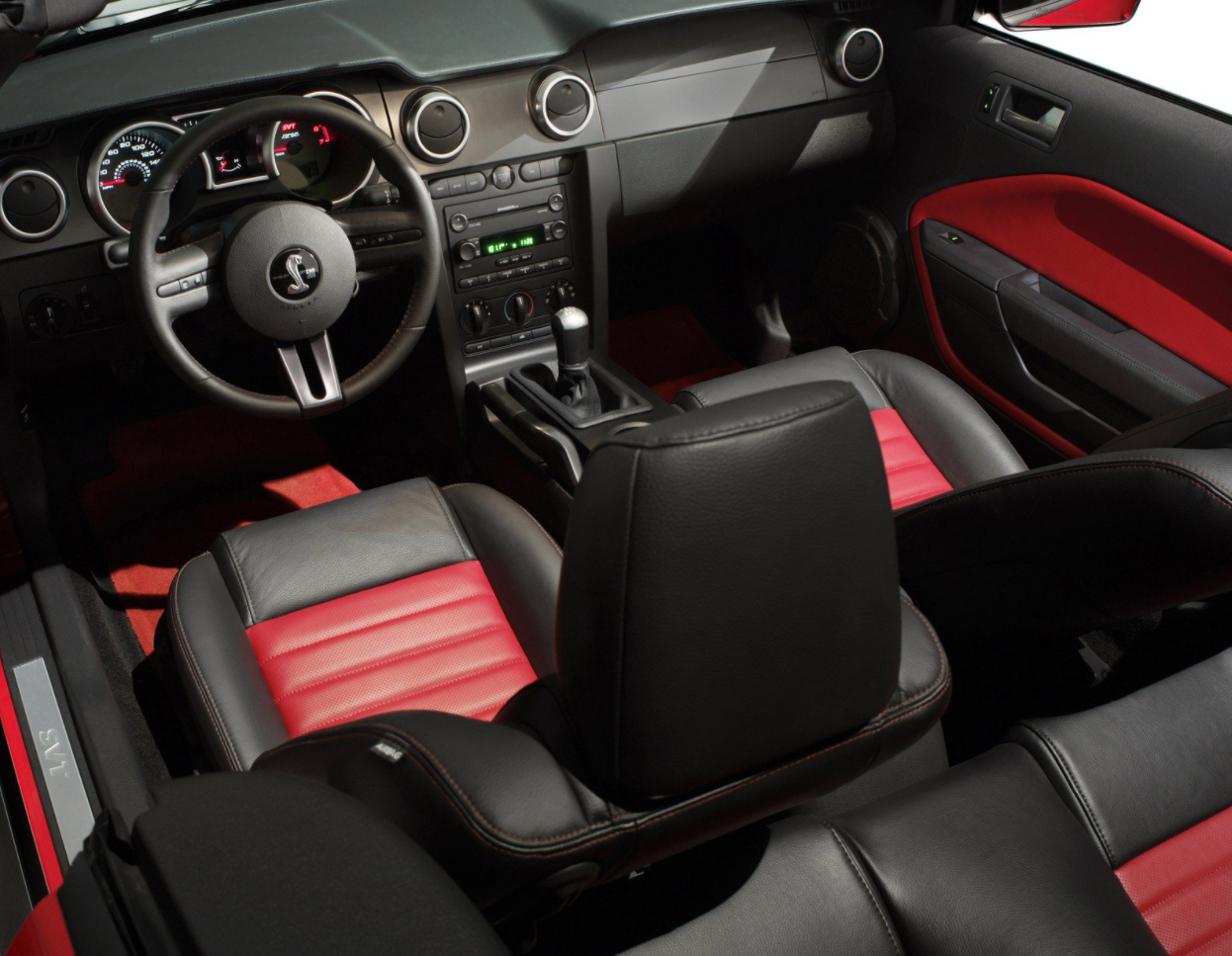
Inside, the GT500 was available in either Charcoal Black leather or a Charcoal Black and Crimson Red leather combination depending on exterior colour choice. The seats offered more lateral support than those available in the Mustang and featured an embossed coil snake insignia. Satin-finish aluminum trim adorned the dash while white faced gauges with a boost gauge faced the driver. The speedometer and tachometer swapped positions and the SVT logo in the tachometer lit-up when the engine approached red-line so that the driver could more easily see when to shift. For a little extra flair the gauge illumination could be switched between a red/blue combination and all white. A unique steering wheel was installed that featured palm grips and was leather wrapped with red stitching. There was also a Cobra logo on the steering wheel hub.
Owners could outfit their GT500 with a couple of luxuries such as Sirius Satellite radio and the Shaker 1000 audio system that replaced the standard Shaker 500 unit. There was also a GT500 Premium Interior Trim package that included wrapped and stitched instrument panel brow and centre console, upgraded door armrests, auto-dimming rearview mirror with compass, and aluminum pedal covers.
Hau Thai-Tang, the S197 Mustang’s chief engineer who had been promoted to director of Advanced Product Creation and head of SVT proclaimed “Our goal was to build the most powerful, most capable Mustang ever.” Well the 2007 Shelby GT500 was certainly the most powerful regular production Mustang ever produced; however there were doubts that it was the most capable. While Ford’s initial performance claims of 0-60 mph in 4.0 seconds, a quarter mile time of 12.5 seconds at 116 mph, and 0.94g on a skid pad seemed to support Thai-Tang’s claims, the GT500 had a hard time repeating those performance numbers in the real world.
Part of the problem lay within the weight of the GT500. This car was decidedly porky weighing in at 3,950-pounds for the coupe, some 300-pounds more than the Cobra it replaced and a staggering 600-pounds heavier than a Chevrolet Corvette coupe. The convertible fairs even worse at a rotund 4,040-pounds. Worse yet, the car was significantly unbalanced with 57 percent of its weight hanging over the front wheels. The toll for wedging that sensational supercharged iron-block V-8 under the hood of the GT500 was pretty high.
Although the GT500 was overweight and nose heavy it was still a sensational performing car with most testers being able register 0-60 mph times of 4.5-4.7 seconds and quarter mile times around 12.8 seconds with the speedometer pointing just past 110 mph. Certainly not slow by any stretch of the imagination, but no faster than the last generation Cobra and many people expected the 500-horsepower GT500 would blow the Cobra off the road.
There are a few reasons for this; there is no doubt that the weight is partially to blame but that isn’t the complete picture. Where the 390-horsepower Terminator Cobra had decidedly underrated advertised horsepower and torque numbers, the GT500 had exactly 500-horsepower as advertised meaning the GT500 had less of a power advantage then would first appear on paper. The other difference is gearing, the Cobra was offered with a rear gear ratio of 3.55:1 while the GT500 had a lower ratio of 3.33:1. This meant that the Cobra could get more of its power down to the ground at a rapid rate than the GT500 could and therefore clip off similar acceleration times.
Although the GT500 was nose heavy, handling was surprisingly predicable and balanced while ride quality was amazingly compliant. The GT500 could turn into a corner crisply with enough grip available to get the car out through the other side without too much drama. When driven aggressively on public roads the GT500 was a complete joy and had capabilities that were far beyond that of the average driver. Plus the relaxed ride made the GT500 a credible daily driver and long distance tourer.
Only when the roads get rough would the solid rear axle rear its ugly head with its heavy unsprung weight bouncing about upsetting the GT500’s handling. Driven to its limits the GT500’s fun factor would quickly diminish as the weight imbalance would highlight the handling weaknesses. The front end would begin to plow and weight transfer to the front end under hard braking only exaggerated the effect making the driver lose some confidence. Back off a touch however, and the GT500 returns to being a thrilling ride, in a good way.
Braking was superb, there is really nothing bad that can be said about a set of fade free, huge Brembo brakes and a solid pedal feeling brake pedal. Hit the pedal hard enough and what or who ever isn’t strapped down inside the car will become air-born!
Overall, the GT500 is a legitimate thrill ride with all its power sliding, tire shredding and throw you back in your seat acceleration madness. It’s fast enough to scare the crap out of you, yet civilized enough to take you anywhere you want to go day in and day out, as long as you can put up with its heavy clutch and stiff gear change. What the GT500 sacrifices in ultimate performance it more than makes up for it with comfort and a heritage that few cars in its class could match.
Specs & Performance
Body
Construction Unitized welded steel body, aluminum hood
Engine
Type: 90-degree, DOHC 32-Valve supercharged V-8
Displacement: 5.4L / 330 CID
Horsepower: 500 hp @ 6000 rpm
Torque: 480 lbs.-ft. @ 4500 rpm
Bore x Stroke: 3.55 in. x 4.17 in.
Compression: 8.4:1
Manufacturing location Romeo, Michigan
Configuration Iron Block and Aluminum Heads
Intake manifold Cast-aluminum with screw-type supercharger and air-to-water intercooler
Exhaust manifold Cast iron
Crankshaft Forged steel
Throttle body Dual 55 mm, electronic
Valvetrain DOHC, 4 valves per cylinder
Valve diameter Intake: 37.0 mm
Exhaust: 32.0 mm
Pistons Forged aluminum
Connecting rods Cracked forged steel I-beams
Ignition Coil-on-plug
Suspension
Front: Modified (reverse-L) MacPherson strut, 34mm stabilizer bar, coil springs
Rear: 3-link solid axle with coil springs, panhard rod, 24mm solid stabilizer bar
Brakes
Front: 14.0 in. vented Brembo disc, four-piston aluminum caliper
Rear: 11.8 in. vented disc, single-piston caliper
ABS: Four channel, four-sensor ABS system with EBD, linked to all-speed traction control
Wheels/Tires
Wheels: 18 x 9.5 in. machined aluminum wheels with SVT center caps
Tires: P255/45ZR-18 (Front); 285/40ZR-18 (Rear); BSW high-performance
Performance
0-60 mph: 4.5 seconds (Motor Trend)
60-0 mph braking: 112 feet (Motor Trend)
1/4-mile @ MPH: 12.6 seconds @ 114.2 mph (Motor Trend)
Production
Total Produced: 10,847
Total Coupe Produced: 8,152
– White: 2,252 (Including 128 w/ Red Package)
– Red: 2,153
– Black: 1,689 (Including 169 w/ Red package)
– Blue: 1,054
– Grey: 384
– Alloy: 338
– Orange: 282
Total Convertible Produced: 2,695
– Black: 859
– Red: 809
– White: 325
– Blue: 283
– Orange: 160
– Grey: 151
– Alloy: 108
Drivetrain
Layout Rear-wheel drive
Transmission
Standard (Type) T-56 6-speed manual
Gear ratios
1st 2.97
2nd 1.78
3rd 1.3
4th 1.0
5th .80
6th .63
Final drive 3.31
Exterior Dimensions
Wheelbase 107.1 in.
Overall length 188 in.
Overall width 73.9 in.
Overall height 55.7 in.
Track width, front/rear 61.9 in. / 62.5 in.
Ground clearance 5.71 in.
Interior Dimensions
Seating capacity 4 passenger
Headroom
Front row 38.8 in.
Second Row 36.3 in.
Legroom
Front row 42.7 in.
Second row 30.3 in.
Shoulder room
Front row 55.4 in.
Second Row 45.0 in.
Hip room
Front row 53.6 in.
Second row 45.2 in.
Cargo Volume 9.7 cu. ft.
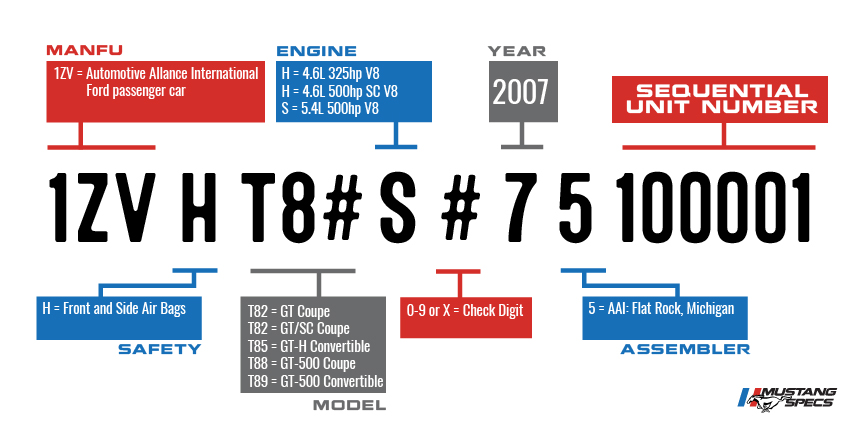
VIN
Pictures
In Depth
Overview
The most powerful factory-built Ford Mustang in history will take to the street next year, following a unique collaboration between performance car legend Carroll Shelby and the Ford Special Vehicle Team (SVT)
Ford took the wraps off the 450-plus horsepower Ford Shelby Cobra GT500 show car at the New Year International Auto Show March 23. Designed in the unmistakable image of Shelby Mustangs of the 1960s, the Shelby Cobra GT500 melds SVT’s modern engineering with the big-block performance that made the original GT500 the king of the road.
“The all-new 2005 Ford Mustang is one of the hottest cars in many years,” says Phil Martens, Ford group vice president, Product Creation. “Its chassis was engineered from the beginning to be the basis of a high-performance, world-class sports car from SVT, and the Shelby Cobra GT500 is it.”
Carroll Shelby lends his support to SVT, adapting his earlier role as a senior advisor on the “Dream Team” that was assembled to develop and build the 2005 Ford GT.
“I’ve worked with the SVT guys for several years now, and I know they have the guts, the talent and the passion to deliver the best performance Mustangs ever,” says Shelby.
A production version of the GT500 will go on sale in 2006, continuing the high-performance lineage of the SVT Mustang Cobra model line. It will be followed by a steady stream of performance products developed by SVT, possibly including a version of the production-intent Sport Trac Adrenalin, the industry’s first performance sport-utility truck.
“SVT led the modern-day factory performance trend with the Mustang Cobra and the industry’s first high-performance truck, the F-150 Lightning,” says Hau Thai-Tang, director, Ford Advanced Product Creation and SVT. “Today, we’re building on that pioneering vision with vehicles like the Ford GT, Shelby Cobra GT500 and Sport Trac Adrenalin – great performance machines that connect with enthusiasts in a way no other companies or vehicles can match.”
The production GT500 will be the first in a string of specialty Mustangs that SVT will help deliver. This will create Ford Motor Company’s – and one of the industry’s – broadest product portfolio, stretching from under $20,000 for the V-6 Mustang coupe to the 450-plus-horsepower GT500, each offering performance and value.
The GT500 and the production-intent Sport Trac Adrenalin teaser accelerate the wave of momentum at SVT since the launch of the 2005 Ford GT supercar. SVT also now will develop non-SVT branded Ford Division performance vehicles – including heritage-based performance Mustangs in the spirit of the 2001 Bullitt GT and 2003 Mach 1 – as it becomes more directly integrated into Ford’s mainstream product development process.
Shelby Cobra GT500’s supercharged 5.4-liter DOHC V-8 produces over 450 hp
Just as the original Shelby GT500 was the “step up” to big-block power from the GT350, the new Ford Shelby Cobra GT500 steps up to Ford’s 5.4-liter “MOD” V-8. The result?
The GT500 is the most powerful factory Mustang ever. Its supercharged 5.4-liter, 32-valve V-8 evolves from SVT’s experience with supercharging the “MOD” engine to deliver more than 450 horsepower and 450 foot-pounds of torque.
The cast-iron-block, four-valve engine is force-fed an air-and-fuel mixture via a screw-type supercharger at 8.5 pounds per square inch of boost. Aluminum cylinder heads, piston rings and bearings sourced from the Ford GT program bring a high level of proven durability to the drivetrain, while upgraded cooling components promise longevity. “Powered by SVT” camshaft covers are the finishing touch to the engine.
“This version of the 5.4-liter V-8 has a higher horsepower rating than any other factory Mustang in history,” says Jay O’Connell, SVT chief vehicle engineer. “It really delivers on the essence of two great names in Ford performance – a mix of SVT’s modern-day experience with supercharging and the Shelby GT500’s heritage of big-block power.”
The engine has been further tuned from its first application in a Mustang, the 2000 SVT Mustang Cobra R, a limited edition model of 300 units.
Helping to put the power of the GT500’s supercharged V-8 to the pavement is a T-56 six-speed manual gearbox. The evenly spaced gears mean less stirring is needed to find the “sweet spot” in keeping the revs “on cam” for power to pass, while at the same time making the most of the engine’s broad torque curve. The heavy-duty transmission has proven itself a willing companion to V-8 power in Mustangs in both road and track environments, including the 2000 SVT Mustang Cobra R, 2004 SVT Mustang Cobra and the new race-winning Ford Racing Mustang FR500C.
The great Shelby Mustangs of the 1960s were anything but one-trick ponies. They earned their stripes on twisty roads and race tracks across America and Europe. The Shelby Cobra GT500 show car continues that legacy of all-around performance.
The GT500 starts with the solid 2005 Mustang underpinnings. The all-new Mustang’s platform was designed from the beginning with performance derivatives in mind, providing an exceptionally rigid, well-engineered starting point for SVT chassis engineers.
Using real-world experience gained during more than 12 years of building great-handling SVT Mustang Cobras, SVT engineers retune and upgrade key chassis components. Improvements such as revised shocks, spring rates and upgraded stabilizer bars help the GT500 stop and turn with the same authority as it goes.
The GT500 features a MacPherson strut independent front suspension with “Reverse L” lower control arms, and a solid-axle, three-link rear suspension with coil springs and a Panhard rod for precise control of the rear axle.
This rear suspension design has been validated on the track by Ford Racing. The race-prepared Ford Racing Mustang FR500C was purpose-built from the base 2005 Mustang body structure and suspension geometry to run in the Grand-Am Cup series, a class of road racing for production-based cars. Competing against the best from Germany and Japan, a Mustang FR500C competed in and won its first ever race in the season-opener at Daytona International Speedway in February 2005.
“SVT and Ford Racing will be working closer than ever as we go forward on future projects, especially Mustangs,” says Thai-Tang, a Ford Racing alumnus who served as the race engineer for the Newman-Haas Racing team in 1993. “The Mustang FR500C racing program is an exact demonstration of the capability we engineered into the mainstream Mustang to be capable of. Now, we have both a Daytona victory and the return of the Shelby Cobra GT500 to showcase Mustang performance possibilities.”
To match this power and handling ability, SVT fitted some of the biggest brakes in the business to the GT500. Fourteen-inch cross-drilled Brembo rotors up front and 13-inch discs in the rear continue SVT’s legacy of great-braking Mustangs. Secure footing is provided by 19-inch wheels wrapped in high-performance tires.
The snake is back – Legendary looks with SVT function
The Shelby Cobra GT500 combines the dramatic design genes of the all-new Mustang with Carroll Shelby’s legendary performance image to create an SVT Mustang that broadens the power brand’s design approach and appeal
“The restrained, performance-oriented SVT design theme has become instantly recognizable to enthusiasts without brash styling cues,” says Doug Gaffka, design director, Ford SVT vehicles. “The GT500 takes a huge leap forward by combining the modern Mustang muscle car with the classic Shelby performance look to expand SVT’s reach to a much bigger audience.”
The 2005 Mustang design team drew inspiration from classic Shelby Mustangs, the models that transformed the mild-mannered pony car into a muscle car with attitude. Envisioning an SVT model, the team tested GT500 design cues on the Mustang GT coupe concept that was unveiled at the 2003 North American International Auto Show. In 2004, designers further developed the GT500 look on the Mustang GT-R, a race-bred concept with the dual purpose of foreshadowing SVT’s Mustang design direction and Ford Racing’s plans to return Mustang to road racing.
The GT500 now comes into full light, punctuated by the classic LeMans-style white stripes that race along the top of the show car’s “SVT Red” paint from nose to tail. The stripes recall the Shelby Mustangs that marked another important 1960’s Mustang transition when Ford put it on the track to becoming a racing legend. The GT500 nomenclature is prominent in the lower bodyside racing stripe, another cue from the classic Shelby Mustangs.
“The new Mustang has classic design cues from some of the best-looking Mustangs of all-time, including the Shelbys,” says Keith Rogman, Mustang senior designer. “The design of the GT500 has been at the forefront of our minds since the outset of the entire Mustang program.”
The Shelby design elements alone are enough to tell the GT500 story but are not the only visual cues that set this Mustang apart. The reworked front fascia features a functional air splitter and the unique hood has heat-extraction ducts, combining to provide improved airflow and aerodynamics. Revised headlamp insets offer a more aggressive look and result in symmetrical upper and lower grilles with large air openings, creating a visual connection to vintage Shelby Mustangs.
The unique rear fascia features strakes inspired by the Ford GT’s integrated rear airflow diffuser, and a rear spoiler reminiscent of a classic GT500. To mark the collaboration of two Mustang performance icons, the GT500 features Shelby and SVT badging.
Continuing the snake logo tradition of past-generation SVT Mustang Cobras, as well as late-model Shelby Mustangs, the fenders each feature an updated design of the Cobra. For the first time on any SVT Mustang, the front grille features an off-center snake in place of the standard running horse. “GT500” is emblazoned inside the side rocker stripes, and the name “SHELBY” is prominently featured across the rear deck. The SVT logo can be seen on the wheel center caps, a signature SVT location, as well as on the doorsill plates. To top if off, the “gas cap” medallion between the taillights reads “Shelby GT500” centered on the Cobra image.
The interior is completely wrapped in ebony black leather, including the top of the dash, door panels and center arm rest. Also wrapped in ebony leather are the shift lever, shift boot and parking-brake handle. SVT Red leather seat and door panel inserts provide a marked contrast to the rest of the leather-trimmed cabin, surrounding the performance enthusiast with luxury and comfort. Snake logos embroidered into the seat backs finish the package.
“We’ve taken leather design trends to a new level by using it on almost every exposed surface in the GT500,” says Rogman. “Leather has long been a performance fashion accessory for enthusiasts, from jackets to racing gloves, so it perfectly matches all the other driving oriented cues.”
The Shelby GT500 script and Cobra image are repeated on the steering wheel cap. Behind the wheel are titanium-faced gauges swapped in location so that the tachometer is dominant visually for the driver. The chrome accessories inside the cabin have been replaced with a satin aluminum finish, including the aluminum shift lever knob that is nicely positioned for quick, positive shifts of the six-speed transmission.
SVT and Shelby: The Legends Grow. With the look and legend one would expect from Carroll Shelby and the kind of power and performance enthusiasts have come to expect from SVT, the GT500 show car points to a brand new era in Ford Motor Company’s performance future.
“Carroll Shelby is truly a living automotive legend, a Ford performance legend,” says Martens. “It’s a dream come true to be able to put the Shelby name on a Mustang again.”
Carroll Shelby first put his name on a Mustang back in 1964 when he was asked to inject some high performance into the brand-new pony car. The result was the GT350R, a lightweight, handling-focused race car that earned the Mustang its first performance credentials. Subsequent Shelby Mustangs included a street version of the race car, the GT350, and what was known as the “rent-a-racer” Mustang, the GT350H, a joint project with the Hertz rental car corporation.
The ultimate Shelby Mustang of the era was the GT500KR, or “King of the Road.” Powered by a big block 428-cubic inch “Cobra Jet” V-8, the GT500KR was one of the most powerful, and memorable, muscle cars of that period. Shelby Mustang production ceased in 1970 with a total volume of 14,559 units.
The Ford Special Vehicle Team brought performance back to Mustang in 1993. After 12 years and with nearly 80,000 high-performance Mustangs on the streets, and a total SVT vehicle production nearing 145,000 vehicles, SVT is primed for growth with the GT500 serving as the foundation for other performance Mustang projects.
By bringing together Carroll Shelby and Ford SVT, the company’s commitment to performance becomes as powerful as at any time in its history – including the famed “Total Performance” days of the 1960s. From the Ford GT supercar, the
GT500, to a rejuvenated Ford Racing Performance Parts program – performance and racing adds luster to its proud brand heritage.
“SVT has been and will remain the leader in performance vehicle engineering and marketing,” says Martens. “SVT remains unique in offering the total performance experience. The return of Carroll Shelby to our performance family only strengthens our firepower.”
Powertrain
Just as the big-block GT500 from 1968 was a step up from the GT350, the Ford Shelby Cobra GT500 show car’s 450-plus-horsepower, 5.4-liter V-8 is a step up from the 4.6-liter V-8 used in the previous-generation SVT Mustang Cobra.
In fact, the 5.4-liter, 32-valve, supercharged V-8 configuration is similar to that of the 2005 Ford GT supercar, offering the right combination of classic Ford big-block power and modern technology. Using the Ford GT as a blueprint, SVT has given the GT500 more total horsepower than any factory Mustang in the muscle car’s celebrated 41-year history.
“We are applying our Ford GT engine experience to the GT500 to bring over 450 horsepower to a much bigger enthusiast audience,” says Jay O’Connell, SVT chief vehicle engineer. “It really delivers on the essence of two great names in Ford performance – a mix of SVT’s modern-day experience with supercharging and the Shelby GT500’s heritage of big-block power.”
The result: More than 450 horsepower and 450 foot-pounds of torque.
Engine upgraded for supercharger’s power increase. With the stout cast-iron, 5.4-liter Triton V-8 engine as a starting point, the Shelby Cobra GT500 adds a screw-type 8.5-pounds-per-square-inch supercharger and water-to-air intercooler.
But, adding forced-induction power is more than just a bolt-on proposition. The engine’s internals need upgrading for the sake of strength and durability. To that end, the Shelby Cobra GT500’s powerplant benefits from unique connecting rods and forged pistons to handle the extra strain on the lower end of the block.
An all-new intake manifold helps to efficiently channel the supercharged fuel-air mixture into the cylinders. The low-profile manifold design also effectively packages the entire induction system under the GT500’s special air-extraction hood. Fuel comes from a dual-bore electronic throttle body borrowed from Ford’s 6.8-liter truck engine program. To manage heat produced by more than 450 horses, a larger radiator and increased-capacity cooling system also are installed.
Aluminum, high-performance Ford GT heads tout “Powered by SVT. While supercharging is a key element in the Shelby Cobra GT500’s ability to generate so much horsepower, another major contributing component is the design of the cast-aluminum, four-valve cylinder heads sourced from the Ford GT supercar.
Developed specifically for supercharged applications, these high-performance heads use high-flow ports and specially calibrated dual-overhead camshafts to deliver optimum engine “breathing” along with surprisingly good fuel efficiency and emissions. Also borrowed for use in the GT500 are the Ford GT’s proven piston rings and connecting rod bearings.
To enthusiasts, the real beauty of any performance car rests with its engine. That idea certainly wasn’t lost on Carroll Shelby because Mustangs that bore his name have traditionally brought his unique sense of style and personality right into the engine compartment. One Shelby signature feature – special finned valve covers embossed with “COBRA Powered By Ford” – soon became the envy of so many Ford V-8 owners that they quickly became one of the best-selling dress-up accessories on the market.
With that in mind, the GT500 is equipped with special “Powered by SVT” finned cam covers to hint at the beauty of 450 horses lurking in the engine below. Mated to the Ford GT four-valve cylinder heads are unique exhaust manifolds that help to better scavenge spent gases out of the cylinders and into the custom-tuned mufflers and dual-exhaust system.
Strong transmission for powerful engine. Few transmissions exist in the marketplace today that can handle the torque loads generated by the supercharged GT500, so SVT engineers are opting to stick with the proven heavy duty performance of the T-56 six-speed manual gearbox. The T-56 first appeared in the 2000 SVT Mustang Cobra R, powered by a naturally aspirated 5.4-liter V-8 with 385 horsepower, and later in the supercharged 2003 SVT Mustang Cobra whose DOHC 4.6-liter produced 390 horses. For the Shelby Cobra GT500 show car, the T-56 will be geared to make the most out of the supercharged 5.4-liter’s broad power band.
Exterior/Interior
powerful wave of nostalgia comes rushing back with a single glance at the Ford Shelby Cobra GT500 show car. Strong visual cues had helped signal the serious performance potential of the great Shelbys of yesteryear. Now the GT500’s striking face and unmistakable Shelby signature announce this thoroughly modern Mustang means business. Melding the Shelby look with SVT’s designed-to-drive philosophy creates an aggressive, classic look with enhanced performance capabilities.
“There’s a huge backdrop in Ford’s Design Studio covered with photos of our favorite Mustangs – many of them 1960’s-era Shelbys,” says Doug Gaffka, design director, Ford SVT vehicles. “When it came to designing the GT500, there’s no question the 1967-68 Shelby Mustangs inspired us. We tried to recreate the surface language of the ’68 Shelby GT500, yet do so in a way that adds to the modern design of the 2005 Mustang – much like Carroll Shelby enhanced the design of the ’67 Mustang.”
The 2005 Mustang design team also drew inspiration from classic 1968 Mustangs, the models that transformed the mild-mannered pony car into a muscle car with attitude. Envisioning an SVT model, the team tested GT500 design cues on the Mustang GT coupe concept that was unveiled at the 2003 North American International Auto Show.
In 2004, designers further developed the GT500 look on the Mustang GT-R, a race-bred concept with the dual purpose of foreshadowing SVT’s Mustang design direction and Ford Racing’s plans to return Mustang to road racing.
Classic Shelby design cues, including LeMans stripes, create instant identity
The GT500 now comes into full light, punctuated by the classic LeMans-style white stripes that race along the top of the show car’s “SVT Red” paint from nose to tail. The stripes recall the Shelby Mustangs that marked another important 1960’s Mustang transition when Ford put it on the track to becoming a racing legend.
The GT500 nomenclature is prominent in the lower bodyside racing stripe, another cue from the classic Shelby Mustangs. The use of contrasting color overbody stripes in auto racing was introduced when the first factory teams employed them on identically equipped and painted cars to help identify the different drivers.
Carroll Shelby adopted the stripes on his successful Cobra roadsters, and they quickly became part of his performance signature. Shelby striped all of his high-performance Fords to follow: the Daytona Coupes, Ford GT40s, Shelby Mustang GT350s and GT500s. To this day, Shelby’s twin stripes are also associated with Ford performance, evidenced by those on the 2006 Ford GT supercar.
Taking a page from Carroll Shelby’s work on the GT500s of the late 1960s, Ford’s design team took aggressive forms and shapes already apparent on the Mustang and further honed them for the GT500’s taut and race-ready appearance. A new front fascia, functional air splitter, larger grilles, hood-mounted air extractors, unique rear fascia and an integrated decklid spoiler are all designs cues that are pure Shelby.
Oversized grilles and functional air extractors designed for aggressive appearance and improved air management
Many Shelby Mustangs were raced – and raced hard. For the cars to consistently perform to their maximum potential, the engines needed to breathe as much cool air as possible. Shelby accomplished this on his cars by opening up the grille area and redesigning the lower valance pan to maximize airflow into the radiator. The Shelby Cobra GT500 employs that same idea with its reconfigured front fascia and oversized upper and lower grilles.
“The GT500’s wide grille openings are imposing like a drop-jawed Cobra ready to strike,” says Gaffka. “If you saw that look coming in your rearview mirror, it would make you move out of the way quickly.”
The restyled fascia not only allows for larger grille openings for increased airflow but it gives a more angled, aggressive edge to the headlamp insets.
“The more aggressive fascia is actually a race-car design borrowed from the Mustang GT-R concept,” explains Mustang senior designer Keith Rogman. “It works well with the overall look of the GT500 because racing has such a strong connection with Shelby.”
Attention was paid to make the upper and lower grille openings above and below the front bumper as symmetrical as possible for a more unified look. The overall shape and form of both openings were designed in deference to the Shelby GT500 circa 1968 – and provide the show car with a face that is strikingly similar to its predecessor.
Ford GT lessons used to design GT500’s functional air splitter, rear spoiler
Very modern air-management technology, however, is evident in the details of the GT500.
Forcing a large amount of cool air into an engine bay is only half the battle of performance cars. It is an equally difficult engineering task to get the hot air out without affecting form or function. To that end, the Shelby Cobra GT500’s aluminum hood incorporates functional twin air extractors to help pull heated air out of the engine compartment and promote air circulation around hard-working components.
“The process we created while working on the body design of the Ford GT really helped us come up with the functional front air splitter and rear spoiler for the GT500,” says Jay O’Connell, SVT chief vehicle engineer. “It was essential that they provide measurable downforce at high speeds without detracting from the classic design.”
The functional front splitter is neatly integrated into the front fascia and helps limit airflow under the car at high speed. The science of air management also was applied to the rear of the GT500 where Ford GT wind-tunnel lessons were used to help design the “high-back,” rear-decklid spoiler.
Modern SVT Mustang Cobra influence completes the GT500 design
The Shelby Cobra GT500 houses distinctive foglights in the lower outside corners of the front fascia – long a signature styling cue of Ford SVT vehicles. While original Shelby GT500s had driving lights set into the grille, the inclusion of the SVT style foglights indicates just how well traditional Shelby and modern SVT design elements work together.
Similarly, Gaffka’s team decided to create a more modern rear fascia featuring diffuser-styled strakes and large cutouts for the dual chrome exhaust tips: “The rear fascia pays homage to the Ford GT supercar because the dramatic diffusers indicate serious high performance as part of the package.
Rather than incorporate the full-across taillamps of vintage Shelby Mustangs, Gaffka’s team kept the traditional tri-bar Mustang taillamps in another nod to blending modern cues with the classic look. The taillamps are separated by a “gas cap” medallion that reads “Shelby GT500” centered on a Cobra image while bold “SHELBY” lettering stretches across the rear deck.
The Cobra snake logo featured on the rear medallion continues the tradition of both the vintage Shelby Mustangs and the modern SVT Mustang Cobras. It also commemorates the first time in thirty-five years a new Mustang has featured the Shelby name.
Continuing the snake logo tradition of past-generation SVT Mustang Cobras, as well as late-model Shelby Mustangs, the fenders each feature an updated design of the Cobra. For the first time on any SVT Mustang, the front grille features an off-center snake in place of the standard running horse. “GT500” is emblazoned inside the side rocker stripes. The SVT logo can be seen on the center caps of the 19- x 9.5-inch aluminum wheels, a signature SVT location over the years, as well as on the doorsill plates.
“We spent a lot of time updating the Cobra logo,” says Gaffka. “The design team was very passionate about painstakingly adding detailed snake scales and adding a sharper edge to the teeth to honor the original.
“The Cobra logo is the perfect icon for the GT500. It represents the history and performance of both Shelby and SVT. And, the Cobra badge shows the future of Mustang performance, melding Shelby and SVT into a thoroughly modern vehicle that still recognizes its legacy.”
Comfort and style have a clear mission in the Ford Shelby Cobra GT500 show car: provide a well-appointed yet businesslike cockpit that clearly appeals to the driving enthusiast. While seating position and comfort are always top priorities for drivers, quality materials and craftsmanship are no less important. Just a single look or touch needs to convey instantly that this is one very special Mustang.
“Today’s Mustang Cobra buyer expects the kind of amenities and a level of comfort and fit and finish that simply weren’t available during the Shelby heydays,” says Doug Gaffka, chief designer, Ford SVT. “But we also know of enthusiasts who believe that a woodgrain dash doesn’t belong in a 1970 Shelby GT500 – or any purposeful performance car. So we sought to exceed the expectations of both in the new GT500.”
The GT500 interior design borrows from the 2005 Mustang’s symmetrical instrument panel and square-arched “eyebrows” on each side of the center stack, paying tribute to the muscle car’s 40-year heritage. The quality materials, precision craftsmanship and technical innovations translate perfectly to the higher-end SVT model.
The GT500 also shares the base architecture’s solid structure, forming the basis for engineering a quiet interior. As a result, enthusiasts will enjoy more of the 450-plus horsepower, all-American V-8’s throaty grumble and less of the wind and road noises that distract from enjoyment of long drives.
Time spent at race tracks to develop the 2005 Mustang pay off in the GT500’s interior ergonomics. The steering wheel, shifter and pedals are all placed optimally for enthusiast driving, ideal for heel-and-toe performance shifting, thanks to the upfront engineering work. The seating position is more natural, supportive and comfortable for drivers – either for spirited track driving or for long stints along the twisties.
“We spent a lot of time developing the 2005 Mustang at race tracks because we knew enthusiast driving traits would benefit all versions of the car, not just the Shelby GT500,” says Hau Thai-Tang, director, Advanced Product Creation and SVT. “These track tests were important for tuning the car and, importantly, for laying out key driving interfaces inside the car.”
Lathered in black leather, even on the dash
The GT500 gives new meaning to the term “leather interior” as the dash, seat borders and door panels are completely wrapped in Black Ebony leather. Also wrapped in ebony leather are the shift lever, shift boot and parking-brake handle.
For visual contrast, the GT500 features satin-aluminum finished trim (rather than traditional chrome) and new “SVT Red” leather seat inserts and door-trim panels provide a marked contrast to the rest of the leather-trimmed cabin, creating a very special driving environment.
Mini-perforated leather seat inserts cover the GT500’s extra-supportive bucket seats for a soft, supple hide that breathes, making for a more comfortable ride. As an added styling touch, Cobra emblems are embroidered on the front seatbacks.
When the driver takes hold of the steering wheel, he or she will instantly know this is a car made for the serious car enthusiast in part due to the substantial size and feel that enhances driver control.
“One change we made in the GT500 interior plays directly into the driver’s hands – literally,” says Gaffka. “We redesigned the leather-wrapped steering wheel so the grips are thicker and better positioned for enthusiast driving. And, of course, the airbag cover had to wear proper GT500 identification.”
SVT-style, titanium-faced instruments and performance shifter keep driver connected
High-performance driving involves keeping track of a myriad of visual inputs, and that includes the regular monitoring of engine and other vehicle system functions. As such, the GT500 has a unique instrument cluster specially designed for the needs of an enthusiast driver.
To enthusiasts, a tachometer is at least as important as a speedometer, and a full array of gauges is a must. As such, the positions of the tachometer and speedometer are reversed on the GT500, making the tachometer the dominant gauge visibly for the driver. Also, the voltmeter gauge is replaced with a boost gauge that monitors the performance and health of the supercharger.
The reorganized gauge faces feature a unique titanium-colored finish, with white lettering – a unique performance cue SVT pioneered on the original Mustang Cobra. At night, the color of the illuminated letters can be modified by the MyColor™ color-configurable instrument panel.
The system consists of three light-emitting diodes – green, blue and red – projected through “light pipe” fittings located on the sides of the speedometer and tachometer. At the driver’s command, these pipes mix various combinations of the three primary colors to create more than 125 unique background color options for the gauges.
The center stack is well designed and uncluttered for easy use of the radio, climate control and other switchgear with minimal driver distraction. The highlight of the driver’s cockpit is the substantial leather-wrapped shifter for the six-speed manual transmission. Reviews of similarly equipped 2005 Mustang GTs promise enthusiasts will appreciate the shifter’s short, smooth shifts just as much as its visual importance.
The GT500 shares the base architecture’s larger dimensions that open more space inside the cabin while providing an aggressive stance and a foundation for great driving dynamics. The benefits include more room for the driver and front- and rear-seat passengers for more comfort on long trips. Importantly, the trunk is more than 10 percent larger to hold more travel gear.
“The tallest drivers in our customer base have not been fully happy with previous Mustangs,” says Jay O’Connell, SVT chief vehicle engineer. “We’ve addressed that in this all-new car, while maintaining the ‘cockpit feel’ essential to a driver’s car. But we wanted to improve comfort for passengers, too. The extra cabin space makes a world of difference on long drives.”
Together, these changes help make the Shelby Cobra GT500 a driver-oriented car that possesses style and comfort – and no woodgrain in sight.
Safety
The dramatic leap in body stiffness achieved by the 2005 Ford Mustang that contributes to the Ford Shelby Cobra GT500 show car’s improved driving performance has a parallel benefit in accident avoidance.
With a body structure 31 percent stiffer in torsional rigidity than the previous generation Mustang coupe, the GT500’s chassis is better able to respond to driver inputs to help control the vehicle in emergency maneuvers. Many of the same structures are designed to help channel crash forces away from occupants by managing deformation and intrusion during an impact.
“The torsional rigidity of the new unibody architecture helps give drivers more control in panic situations while Ford’s latest side-impact protection technologies help manage crash forces if an accident cannot be avoided,” says Jay O’Connell, SVT chief vehicle engineer.
The show car’s front structure is designed to absorb energy in a controlled manner and help dissipate it before it can reach the passenger compartment. The 2005 Mustang’s front rails have an octagonal shape designed to distribute crash forces and progressively deform for increased protection in demanding, offset frontal crashes.
Combine a stiffer chassis with features such as all-speed traction control, anti-lock brakes (ABS) and Ford’s Personal Safety System™, and overall passenger protection is enhanced. When you add in the driver and front-passenger side-impact air bags, the GT500 provides a comprehensive safety package.
The Ford Personal Safety System™
The GT500 features Ford’s Personal Safety System™, a cutting-edge safety technology package. The system provides increased protection in frontal crashes by predicting crash severity and deploying restraint devices. The Personal Safety System™ utilizes dual-stage driver and front-passenger air bags – capable of deploying at full or partial power – as well as safety belt pre-tensioners and energy management retractors.
Standard front-passenger classification sensing builds on the strength of the Personal Safety System™ to tailor deployment of the front-passenger air bag. If the passenger seat sensor detects no weight – or very little weight, like a briefcase or purse – the passenger air bag is automatically deactivated. If more weight is detected on the seat, such as that of a small child, the air bag remains deactivated and an instrument panel light alerts the driver. If a larger, adult-size occupant is in the passenger seat, the air bag automatically switches on.
Environment
The Ford Shelby Cobra GT500 show car provides a powerful choice in an efficient and clean package, especially considering muscle cars of the past.
“When you consider pony cars of the 1960s, today’s engines produce approximately double the power, four times the fuel economy and 100 times fewer emissions,” says Tom Jones, Ford SVT program engineer.
Performance cars have evolved dramatically since their heyday in the 1960s. In terms of safety, efficiency and refinement, today’s street machines totally outperform their elder muscle car colleagues in nearly all categories. Yet the story is seldom told about the tremendous gains made in reducing emissions while increasing overall power output.
The fact is the GT500 is easily twice as powerful as the hottest V-8 package offered when Mustang was first introduced – yet still produces from 100 to 300 times fewer emissions. Additionally, today’s modern “MOD” V-8 powertrain enjoys a nearly 60-percent increase in average fuel economy compared to corresponding Ford products produced 30 years ago.
Back in the so-called Muscle Car era, driving a street beast with more than 400 horsepower was a dicey proposition. When dual carburetors, progressive linkage and dual-point ignitions were part of the equation, performance came with a price – drivability. Running too lean or too rich – or with the timing or spark out of adjustment could mean it would misfire or “carbon up” – sometimes with thick, black smoke coming from the tailpipe. Worse yet was fuel economy, with most of the big, high-powered V-8s at the time netting anywhere from six to 10 miles per gallon (mpg) in typical driving.
Ford’s “MOD” V-8 family of engines make more power than anything out of the factory in the past, yet tops 20 mpg on the highway and meets the government’s LEV-II tailpipe emissions standards.
Multi-valve engine technology improves both power and efficiency
Modern, race-derived technology provides an interesting power comparison: The GT500 with a 5.4-liter, DOHC, supercharged V-8 produces nearly 100 horsepower more with nearly 100 fewer cubic inches versus the 1967 Shelby GT500’s 355-horsepower, 428-cubic-inch-displacement, big-block V-8.
Creating a powerful engine means designing it to be as efficient as possible, making the most of the fuel and air that makes it run. The benefits are not only seen in overall power, but in reduced emissions and improved fuel economy as well.
“People may not realize that typical hot-rodding techniques involve improving an engine’s efficiency to extract more power from every ounce of fuel that is burned,” notes Jay O’Connell, SVT chief vehicle engineer. “It’s an unexpected benefit automakers get from racing – the tricks to winning on the racetrack can help make cleaner, more fuel-efficient vehicles for the street.”
For example, the GT500 uses four-valve, double-overhead-cam cylinder heads for optimum engine “breathing.” Using multiple valves per cylinder provides the engine with a more efficient airflow, generating higher peak horsepower. As an additional benefit, multi-valve engines better utilize the air-and-fuel mixture in the cylinders with less waste and unburned fuel vapor. Also, multi-valve engines are better suited to help scavenge exhaust gases out of the cylinder after combustion is complete for more power with cleaner tailpipe emissions.
In addition, supercharging produces the peak horsepower of a much larger-displacement, naturally aspirated engine. Yet, at lower throttle applications, the smaller displacement enabled by supercharging consumes less fuel, resulting in increased fuel economy and lower emissions.
As a result, the Shelby Cobra GT500 show car is designed not only to be the most powerful Mustang from the factory but also one of the cleanest

What brand and rating supercharger oil should I use for a 2007 Ford Mustang Shelby GT500
Can I use a same rating AC Delco Synthetic Oil for my supercharger?